

Discover the Charm of Traditional Irish Women’s Clothing
To walk through the history of Ireland is to trace the threads of its textiles. The story of traditional Irish women’s clothing is not merely one of fabric and stitch, but a vibrant narrative woven from the land itself—its politics, its struggles, its identity, and its unyielding spirit. This attire, often romanticized yet deeply practical, served as a canvas upon which the story of a people was painted. From the early Gaelic túnaic to the iconic shawls of the 19th century, each garment speaks of resilience, adaptation, and a quiet, powerful assertion of cultural pride. This exploration seeks to move beyond the leprechaun-green caricatures, delving into the objective history, cultural significance, and enduring legacy of these garments, revealing why they remain a point of fascination and a source of inspiration far beyond Ireland’s shores.
The Foundations: Early Gaelic Attire and the Léine
To understand the evolution of traditional Irish women’s clothing, one must begin with the foundational garments of early Gaelic society. Prior to the significant English influences of the 16th and 17th centuries, Irish dress was distinct and functional. The primary garment for both men and women was the léine (pronounced ‘lay-nuh’), a long, loose-fitting tunic typically made from linen. For women, the léine could reach ankle-length and was often worn with a sleeveless tunic called an inar over it. The quality and color of the linen were immediate indicators of social status. As noted in historical analyses from University College Dublin’s folklore archives, the wearing of brightly colored léinte, particularly saffron yellow, was a noted feature of Gaelic nobility and became a subtle form of cultural resistance after the imposition of English sumptuary laws which sought to suppress distinct Irish dress. These laws, such as the 1537 Act which stated the Irish must wear English apparel, were not merely about fashion but were a direct assault on Gaelic identity, making the choice to wear a léine a politically charged act. The clothing was layered for practicality in a damp, variable climate, and the use of woolen mantles or cloaks, known as brats, provided essential protection from the relentless Irish rain. These cloaks, often fringed and sometimes brightly striped or checked, were versatile garments used as both coat and blanket, embodying the pragmatic essence of early Irish dress.

The 19th Century: Shawls, Poverty, and Symbolic Resilience
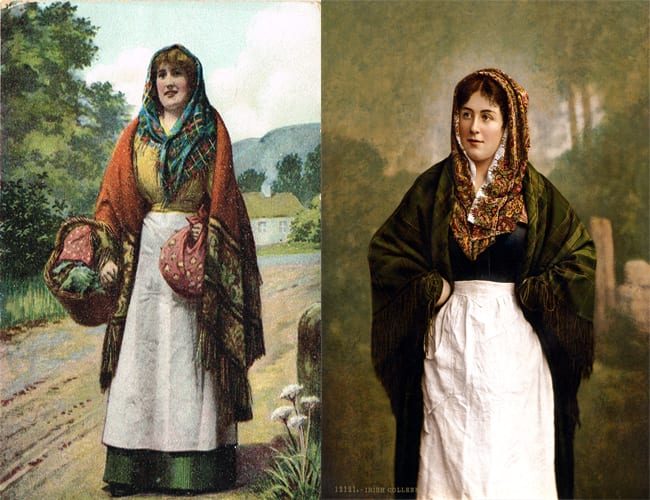
If one image encapsulates 19th-century Irish women’s dress in the popular imagination, it is that of a woman wrapped in a large, warm shawl. This period, marked by the Great Famine (1845-1852) and mass emigration, saw the practical evolution of traditional Irish women’s clothing into a symbol of both hardship and endurance. The voluminous woolen shawl became ubiquitous. It was a multifunctional garment: it kept women warm in poorly heated homes and while working outdoors, it could swaddle an infant, carry parcels, or provide a modicum of privacy. The “Galway Shawl,” a specific style often with a deep, patterned border and fringed edges, became particularly famous. Its prominence is not just folklore; social historians like Dr. Claudia Kinmonth, author of Irish Rural Interiors in Art, have extensively documented its use through paintings and photographs, noting how the shawl effectively replaced the earlier cloak as the outermost layer for working-class women. The choice of a shawl over a coat was largely economic—a shawl required less structured tailoring and could be woven at home. Furthermore, the color and quality held meaning. A fine, brightly colored shawl might be a prized possession for special occasions, as seen in the writings of William Carleton, a 19th-century Irish writer who documented peasant life. In this era, clothing was rarely just adornment; it was a testament to survival. The shawl-clad woman, immortalized in figures like the iconic “Róisín Dubh” (Dark Rosaleen), a poetic personification of Ireland, became a potent national symbol of suffering, motherhood, and unwavering strength in the face of catastrophe.

The Rise of “Irish Poplin” and Bourgeois Fashion
Parallel to the narrative of rural poverty existed another thread in the tapestry of Irish dress: the development of a luxury textile industry, most notably centered on Irish poplin. This fabric, a unique blend of silk warp and wool weft, created a fine, corded material with a subtle sheen and great durability. Produced primarily in Dublin, Irish poplin became highly sought-after in the 18th and 19th centuries. It represents a fascinating intersection of craft, commerce, and national identity. As cited in the National Museum of Ireland’s textile collections, poplin was used for the gowns of the Anglo-Irish aristocracy and for the vestments of clergy, but it also became a material of choice for the emerging Catholic middle class who wished to display both prosperity and Irish pride. A gown made of Irish poplin was a statement. It said the wearer supported domestic industry and possessed refined taste. This adoption of a luxury traditional Irish fabric by the bourgeoisie complicates the simplistic view of Irish dress as solely the domain of the poor peasant. It shows a conscious effort to cultivate and consume a distinctly Irish product, a sentiment echoed in the “Buy Irish” campaigns that would periodically surface. The novelist and Dublin native, James Joyce, even references the fabric in Ulysses, subtly anchoring his characters in the material culture of their city. Thus, Irish poplin gowns stand as a testament to the adaptability and marketability of Irish textile tradition, catering to a different, but equally important, segment of society.
Arans and Claddaghs: 20th Century Reinvention and Global Recognition
The 20th century witnessed the transformation of specific elements of Irish dress from practical, regional wear into globally recognized symbols of Irish heritage. Two prime examples are the Aran sweater and the Claddagh ring, though the latter is jewelry, its story is inextricably linked to the cultural packaging of “Irishness.” The heavy, cream-colored Aran sweater, originally knit by women on the Aran Islands for their fisherman husbands and sons, is perhaps the most successful global ambassador of Irish craft. Its complex cable, diamond, and honeycomb stitch patterns, long romanticized as family-specific “clan crests” or symbolic prayers for safety (the cable for fisherman’s ropes, the diamond for fishing nets), are, as textile scholars from the Folklore of Ireland Society clarify, more likely 20th-century innovations that drew upon earlier knitting traditions. Their explosion in popularity from the 1950s onwards, fueled by export companies and iconic photographs of actors like Steve McQueen wearing them, turned them into a must-have item. They transitioned from a vital, oiled garment meant to protect against the Atlantic spray to a fashionable symbol of rustic wisdom and connection to ancestral roots. Similarly, the traditional Irish women’s clothing of the mid-20th century, often seen in staged “colleen” photographs for tourists, frequently featured a shawl worn over a simple dress, accessorized with a Claddagh ring. This staged image, while often nostalgic and simplified, served to crystallize a marketable, romantic vision of Ireland. It created a tangible link for the diaspora and enthusiasts, offering a piece of heritage that could be worn. This commercial reinvention ensured the survival and global reach of these styles, even if in an adapted form.
Modern Interpretations and Ceremonial Use
Today, traditional Irish women’s clothing is rarely worn as everyday attire but finds powerful expression in two key areas: contemporary fashion and life-cycle ceremonies. Modern Irish designers frequently mine historical garments for inspiration. The sweeping lines of a cloak, the intricate knotwork reminiscent of the Book of Kells translated into embroidery, the use of rugged tweeds and linens—all are reimagined on runways from Dublin to London. Designers like Simone Rocha and the late, great Sybil Connolly (famous for her “Irish linen handkerchief dresses”) have built international reputations by innovating upon traditional fabrics and silhouettes. Connolly, in a 1960s interview for Vogue, famously stated: “I have always believed that fashion should have its roots in the past.” This philosophy drives the modern reinterpretation. Furthermore, for pivotal moments like weddings, elements of tradition are often incorporated with deep meaning. A bride might wear a piece of Carrickmacross or Irish lace that has been passed down through generations, or she may choose a dress made of Irish linen or tweed. The traditional Irish shawl, perhaps in a delicate cashmere rather than heavy wool, is a popular accessory. This ceremonial use is less about historical accuracy and more about creating a tangible, tactile connection to heritage and family at a moment of profound personal significance. It allows individuals to actively participate in the ongoing story of Irish culture, wearing a chapter of its history on their most important days.

A Living Fabric: Why Tradition Endures
The enduring charm of traditional Irish women’s clothing lies in its profound duality. It is both artifact and alive, a record of hardship and a celebration of identity. It tells a story of a people who were told to change their dress and, in various ways—from the defiant wearing of saffron léinte to the home-knit Aran sweater—found methods to preserve a thread of distinction. The garments are scientifically fascinating as records of material culture, showing adaptation to environment and economy. Culturally, they serve as powerful symbols, whether of maternal strength in the shawl, skilled craft in the poplin, or familial love in the Aran stitches. From the authoritative archives of university collections to the personal testimonials shared on platforms like YouTube by historians and wearers alike, the narrative is consistent: these clothes are vessels of memory. They connect the modern wearer, whether an Irish descendant in Boston or a fashion enthusiast in Tokyo, to a landscape, a history, and a resilient spirit. They remind us that clothing is never just fabric; it is a language. And the language of traditional Irish dress speaks eloquently of protection, pride, and an unbroken connection to the past, continuously rewoven for the present.