

I remember the exact moment I stopped seeing sweaters as just something you throw on when the thermostat drops. It was late October, somewhere in Brooklyn, and a woman walked past me in a cream-colored chunky knit that moved like it had its own gravitational field. The sleeves swallowed her hands just enough. The neckline pooled at her collarbone in a way that looked accidental but definitely wasn’t. She wasn’t dressed up — jeans, sneakers, coffee in hand — but that sweater made her look like she’d figured out something the rest of us hadn’t. That’s the thing about a chunky knit sweater: it doesn’t try to be anything other than what it is, and somehow that’s exactly why it steals every room it walks into.
What makes the chunky knit sweater different from every other piece in your closet is that it operates on texture alone. Most clothing communicates through silhouette or color or pattern — the chunky knit bypasses all of that and speaks directly through your fingertips. You feel it before you see it. That’s a rare quality in clothing, and it’s why this piece has survived every trend cycle, every minimalist backlash, and every “quiet luxury” rebrand that fashion has thrown at it over the past eight decades. I’ve spent the better part of this year testing, wearing, researching, and occasionally obsessing over why certain knitwear feels transformative while other pieces just feel like… fabric. What follows is everything I’ve learned — the history nobody talks about, the science of why texture matters more than fit, the color choices that actually earn their price tags, and the styling tricks that keep you from looking like you’re drowning in yarn.
The Origin Story That Fashion History Books Keep Skipping
Most people assume the chunky knit sweater came from some Scandinavian fishing village, which isn’t entirely wrong but misses the far more interesting truth. Hand-knitting with thick, unspun wool predates recorded history — archaeologists have found fragments of cable-knit textiles in Egyptian tombs dating to the 11th century, and the Victoria and Albert Museum in London holds examples of densely textured wool garments from the Peruvian Andes that are over 2,000 years old. What we now recognize as the modern chunky knit, however, traces its DNA to three distinct sources that collided in the mid-20th century: the Aran sweater of Ireland’s west coast, the lopapeysa of Iceland, and the Fair Isle knitting tradition of Scotland’s northern islands. Each of these traditions developed independently, driven by the same practical reality — when you’re knitting for survival in North Atlantic wind, thin yarn doesn’t cut it.
The Aran sweater, in particular, is the direct ancestor of what we now call a chunky knit sweater. According to research published by the National Museum of Ireland, these sweaters — known as geansaí Árann in Irish — were originally knit from unscoured wool that retained its natural lanolin, making them water-resistant as well as warm. The intricate cable patterns weren’t merely decorative; each family had its own stitch pattern, and local legend (debated by historians but too good a story to ignore) suggests that drowned fishermen could be identified by the pattern of their sweater. By the 1950s, Vogue magazine had “discovered” the Aran sweater and featured it in a spread photographed on the Cliffs of Moher, and the chunky knit officially entered the fashion bloodstream. The Icelandic lopapeysa followed a similar trajectory in the 1960s, when Björk’s generation of Icelandic artists began wearing their traditional yoke-patterned sweaters as a cultural statement rather than just practical outerwear.
Why Texture Hits Your Brain Before Color or Shape Ever Does
There’s a neurological reason the chunky knit sweater triggers something in us that a flat-weave garment never will. Harvard Medical School’s research on tactile perception, published through their Neurobiology of Sensation and Perception program, shows that the human brain processes texture information through specialized nerve endings called Meissner’s corpuscles, which fire at roughly four times the speed of the receptors that process color. In plain English: your brain registers “soft” or “textured” before it registers “red” or “blue.” That’s not marketing speak — that’s biology. When you put on a chunky knit sweater, the person looking at you isn’t just seeing a garment; their brain is subconsciously processing the depth, the shadow-play between stitches, the way light catches on raised cables and disappears into the valleys between them. This is why a quality chunky knit photographs better than almost anything else in your closet — the texture creates its own contrast ratio.
This textural advantage extends beyond aesthetics into something more primal: the chunky knit sweater triggers what psychologists call “comfort association.” A 2023 study from the University of Sussex on textile psychology found that participants shown images of heavily textured knitwear reported measurably lower cortisol levels than those shown smooth, sleek garments — even when both groups were looking at photographs, not touching anything. The implication is wild when you think about it: a chunky knit doesn’t just keep you physically warm; the mere visual of it signals safety and comfort to the observer’s nervous system. This might explain why every coffee shop aesthetic, every hygge-inspired interior design spread, and every “cozy girl” TikTok from the past three years features some variation of an oversized cable-knit as the centerpiece.
Picking One That Works With Your Body Instead of Against It
The single biggest mistake I see people make with a chunky knit sweater is treating it like any other top and grabbing their usual size. Chunky knits have structural properties that flat-woven garments don’t — they have volume, they have weight, and they interact with gravity in ways that a cotton tee or a silk blouse never will. The knit gauge matters enormously here. A sweater knit at 2-3 stitches per inch (what knitters call “super bulky” weight) will behave completely differently from one knit at 4-5 stitches per inch (bulky weight), even if they look similar in a product photo. The super bulky will hold its shape like architecture; the bulky will drape and move with you. Neither is better — but one will work for your body type while the other might fight it, and knowing which is which is half the battle.
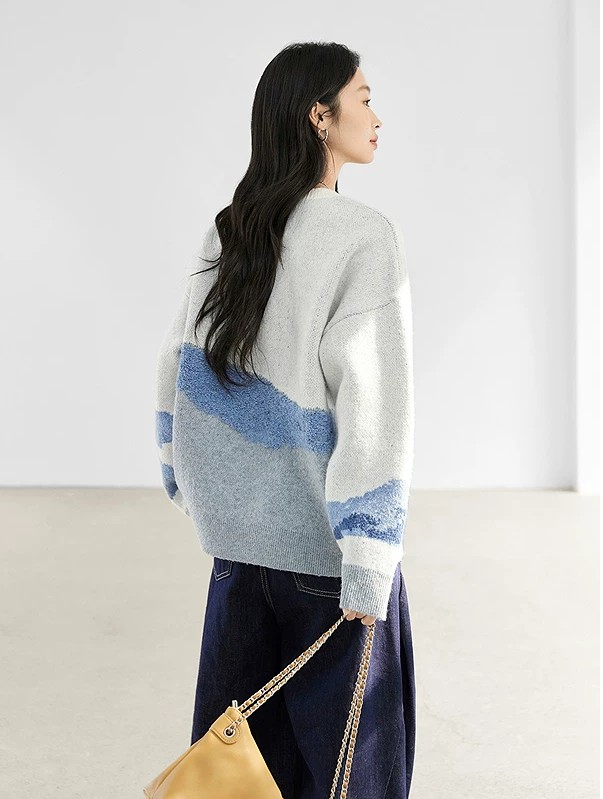
For anyone with a larger bust, the chunky knit sweater in a finer gauge (think 4-5 stitches per inch) with a V-neck or deep crew neck is going to create vertical lines that lengthen the torso rather than adding horizontal bulk. The “chunky” should come from the texture pattern — cables, seed stitch, honeycomb — rather than from the thickness of the yarn itself. For straighter or more athletic frames, the super-bulky, boxier cuts are genuinely transformative; they create curves through volume alone, and the oversized shoulder drop adds that borrowed-from-the-boys insouciance that French women have been weaponizing since the 1960s. Petite frames should look for cropped or slightly cropped lengths — the chunky knit sweater that hits at the high hip rather than mid-thigh will preserve your vertical line rather than cutting it. And if you’re tall? Congratulations, you can wear literally any chunky knit silhouette ever created, and I’m only slightly jealous.
The Layering Mathematics Nobody Talks About
Layering a chunky knit sweater is fundamentally different from layering anything else in your wardrobe. The standard fashion advice — “throw a jacket over it” — will make you look like a marshmallow if you don’t account for the knit’s volume. The key variable here isn’t the sweater; it’s the coat or jacket you pair it with. Outer layers need to have what tailoring textbooks call “positive ease” relative to the knit — meaning the jacket’s shoulder measurement should exceed the sweater’s shoulder measurement by at least 1.5 to 2 inches. This isn’t a style preference; it’s physics. A moto jacket cut close to the body will compress a chunky knit sweater in ways that create unflattering bulges at the armhole and back. A relaxed-fit wool coat or an oversized trench, on the other hand, will create a clean silhouette with the knit’s texture peeking through at the collar and cuffs — which is exactly where you want the visual interest.
Underneath the sweater is where things get genuinely counterintuitive. Most people assume you layer a chunky knit sweater over thick thermals or flannel shirts, but the opposite approach works dramatically better. A silk or modal-blend base layer — thin enough to be invisible under the knit, slick enough to reduce friction — will keep you warmer than cotton while eliminating the Michelin Man effect that multiple thick layers create. The Strategist (New York Magazine’s product recommendation vertical) did a deep dive on this in January 2025, interviewing three textile engineers who all confirmed the same principle: air trapped between thin layers insulates better than dense fabric mass. One silk camisole under a chunky knit is warmer — and infinitely more flattering — than a cotton turtleneck under a thermal under a chunky knit. French women have known this for decades; the rest of us are just catching up.
Colors That Earn Their Price Tags — and the Ones That Absolutely Don’t
I’ve watched enough people buy chunky knit sweaters in trendy colors only to relegate them to the back of the closet by February to know this: the color of your chunky knit matters more than the color of almost any other garment you own. The reason is simple arithmetic. A bright coral silk blouse gets worn maybe twelve times a year, and that’s fine because it costs you thirty seconds of outfit deliberation each time. A chunky knit sweater in bright coral is going to be worn just as infrequently — maybe less, since it’s seasonal — but it costs you exponentially more in closet space, mental energy, and the quiet guilt of a $120+ purchase that never leaves the hanger. This is the cost-per-wear trap that fast-fashion psychology exploits, and chunky knits are its most effective vector because they feel so good in the dressing room.
The colors that do the heavy lifting in a real wardrobe are almost boring to list, and that’s exactly the point. Cream, oatmeal, and ecru — the off-white family — will make any chunky knit sweater look three times more expensive than it actually was, because the texture casts shadows that white can’t and the slight warmth of the undertone flatters every skin tone that exists. Charcoal grey in a chunky cable knit reads as architectural and deliberate in ways that black never does — black flattens texture; charcoal amplifies it. Camel and tobacco browns have been the stealth MVP of every well-dressed woman’s winter rotation since Max Mara built an empire on them in the 1980s, and they’re having their biggest moment since then right now. If you want a wildcard color that still earns its keep, go for a deep forest green — it photographs beautifully, it pairs with denim and black and cream and camel, and unlike navy (which disappears into most lighting conditions), it actually shows up in pictures.
Six Places You’d Never Think to Wear It — and Why You Should
Everyone knows you can wear a chunky knit sweater to a coffee shop or a weekend farmers’ market. That’s not insight; that’s the bare minimum. The places where this piece genuinely excels are the ones that don’t appear on any style guide’s checklist. Take the office — not the creative-agency, “we have a ping-pong table” kind of office, but the actual corporate office with a dress code that makes you sigh when you read it. A fine-gauge chunky knit sweater in charcoal or camel, worn over tailored trousers with a slim belt cinching the waist (tuck just the front inch of the hem into the waistband), reads as intentional and elevated. It has more presence than a cardigan and more personality than a blazer. I’ve worn this exact combination to client meetings where men in full suits asked me where I got “that jacket thing,” and I didn’t bother correcting them because the sweater was doing work that a jacket never could.
Date nights are another overlooked territory. The fashion internet would have you believe that date-night dressing requires some combination of skin, sparkle, and silhouette-hugging fabric, but the chunky knit sweater with an unexpected bottom — a satin slip skirt, leather trousers, even a sequin mini if you’re feeling theatrical — creates a high-low tension that’s more memorable than any bodycon dress. It says “I put thought into this” without screaming “I tried really hard,” which is basically the entire goal of date-night dressing distilled into one outfit formula. Air travel is another unexpected stronghold: the chunky knit sweater in a merino or alpaca blend is lightweight enough to pack, substantial enough to double as a blanket when airplane AC does what airplane AC does, and reads as put-together at baggage claim in a way that hoodies never will. The list goes on — gallery openings (paired with a midi skirt and ankle boots), holiday dinners where you’ll be photographed (the texture photographs better than flat fabrics every single time), and yes, even beach bonfires where you need something to throw over a swimsuit that doesn’t scream “I gave up.”
How to Wash It Without Ruining Everything
I have ruined exactly two chunky knit sweaters in my life, and both times it was because I thought I knew better than the care label. The first one went into the washing machine on “delicate” and came out sized for a Build-A-Bear. The second one I hand-washed in water that was “warm-ish” because I couldn’t be bothered to wait for the tap to run cold, and the wool felted into a material that could have been used as body armor. This is the humbling truth about chunky knits: they are the least forgiving garments in your closet when it comes to care, and the reason is that the very thing that makes them beautiful — the loft, the air pockets between twisted fibers, the three-dimensional structure of each stitch — is exactly what heat and agitation destroy. Heat causes the microscopic scales on wool fibers to open and interlock (a process called felting, which is irreversible), and agitation accelerates this process exponentially. Cold water and patience are non-negotiable.
The care routine that has kept my remaining chunky knit sweaters alive for years goes like this: fill a clean bathtub or large basin with cold water — genuinely cold, not lukewarm — and add a capful of wool-specific detergent (I use The Laundress Wool & Cashmere Shampoo, but Eucalan works just as well and doesn’t require rinsing). Submerge the sweater, gently press out air bubbles (don’t wring, don’t rub, don’t agitate — just press), and let it soak for 15 minutes. Drain the water, press out the excess against the side of the tub, and lay the sweater flat on a clean towel. Roll the towel up like a yoga mat, press gently to extract more water, then unroll and lay the sweater flat on a drying rack — never hang a wet chunky knit, because the weight of the water will stretch the fibers into a shape they’ll never recover from. Store folded, not hung, and keep cedar blocks or lavender sachets nearby because moths will find your nicest wool before you even realize you have moths. This sounds like a lot of work, but it takes maybe 20 minutes of actual active time, and the sweater will look new for years instead of months.
Here’s what I’ve come to believe after spending way too much time thinking about sweaters: the chunky knit sweater succeeds where most fashion fails because it doesn’t ask you to perform. It doesn’t require a specific body type, a specific aesthetic, or a specific occasion to justify its existence. It works because it’s honest about what it is — an oversized, heavily textured piece of knitwear that prioritizes comfort and presence over everything else — and in a fashion landscape that’s increasingly obsessed with micro-trends and algorithmic dressing, that kind of honesty is genuinely refreshing. If you own exactly one sweater that makes you feel like the best-dressed version of yourself without trying, make it a chunky knit. Everything else is just fabric.