

There is a particular magic to pulling a dress from your closet that feels like it has lived a life before it ever met you. Denim dresses carry that weight. They arrive with history baked into every seam — the stiff newness of raw indigo, the soft surrender of a garment that has been washed a hundred times, the quiet confidence of something that never needed to try too hard. I started my denim dress collection with a thrift store find that cost twelve dollars and smelled faintly of someone else’s detergent. Five years later, I own seven of them, and that first one still hangs in my closet like an old friend who refuses to be retired. The denim dress is not merely a trend; it is a timeline of modern fashion itself, a garment born in the grit of 19th-century labor that somehow ended up on the runways of Paris, Milan, and New York without ever losing its blue-collar soul.
The Accidental Icon: How Workwear Became High Fashion
The story of the denim dress begins not on a runway but in a gold mine. In 1873, Jacob Davis and Levi Strauss received a patent for riveted denim work pants, and denim was born as the uniform of the American laborer. According to the Levi Strauss & Co. Archives, the company’s official historical records maintained at their San Francisco headquarters, denim was originally chosen for its incredible durability — miners and railroad workers needed clothing that could withstand brutal conditions without falling apart. It would take nearly a century for designers to look at this indigo-dyed cotton twill and see something other than utility. The shift happened gradually: in the 1950s, Hollywood rebels like James Dean and Marilyn Monroe wore denim as a symbol of youthful defiance; by the 1970s, the counterculture movement had claimed it entirely. But the denim dress as a distinct fashion category didn’t truly emerge until the late 1970s and early 1980s, when designers began experimenting with the fabric beyond pants and jackets. The pinafore-style denim dress of that era — often worn over a white t-shirt with scrunched socks and sneakers — was less a fashion statement and more a declaration of casual independence. It said: I am comfortable, I am practical, and I do not need your approval. That attitude has never really gone away.
What makes the evolution of this garment so fascinating is its resistance to being pinned down to any single era or aesthetic. Unlike the miniskirt, which will forever be associated with the 1960s, or the power suit, which screams 1980s, the denim dress has shape-shifted through every decade without becoming a costume piece. In the 1990s, it went grunge with frayed hems and oversized silhouettes. In the 2000s, it got sleek and body-conscious, often featuring stretch denim blends that hugged every curve. The 2010s brought back the button-front shirt dress in rigid selvedge denim, a nod to heritage workwear that fashion insiders couldn’t get enough of. And now, in the mid-2020s, we are seeing a denim dress renaissance that draws from all of these eras simultaneously — vintage-inspired washes paired with modern tailoring, traditional indigo alongside bleached-out pastels, utilitarian details softened by feminine cuts. The garment has become a canvas for the entire history of denim itself, and the result is something that feels both timeless and urgently current.
The Numbers Behind the Blue: What the Data Reveals About Denim Dresses
You could talk about fashion in purely aesthetic terms — and I have, for years — but the numbers tell a story that adjectives cannot. According to Statista’s Global Apparel Market Report 2025, the global denim market was valued at approximately $63.5 billion in 2024 and is projected to reach $87.4 billion by 2030, growing at a compound annual rate of roughly 5.4 percent. Within that massive category, denim dresses and jumpsuits represent one of the fastest-growing segments, outpacing traditional denim jeans in year-over-year growth by nearly 2 percentage points. The data comes from Statista’s comprehensive analysis of retail sales, import-export figures, and consumer survey data across 40 countries. What this tells me is that the denim dress is not just having a moment — it is undergoing a structural shift in how consumers allocate their wardrobe budgets. Shoppers are increasingly choosing the one-and-done convenience of a dress over the two-piece commitment of jeans and a top, and denim gives that dress the durability and casual versatility that lighter fabrics cannot match.
Consumer search data reinforces this picture. Google Trends data from January 2023 through March 2026 shows a 47 percent increase in global search interest for “denim dress” over that three-year period, with particularly sharp spikes every spring and early summer as shoppers refresh their warm-weather wardrobes. The United States, United Kingdom, Australia, and Canada lead the search volume, but interest is growing fastest in markets like India, Brazil, and Southeast Asia — regions where rising middle-class disposable income is intersecting with global fashion trends in unprecedented ways. What I find most telling is the related queries: searches for “denim dress outfit ideas,” “how to style denim dress,” and “midi denim dress” have all increased by more than 60 percent in the same period. People are not just buying these dresses; they are actively seeking guidance on how to wear them, which suggests a category that has moved from niche curiosity to mainstream wardrobe essential. The denim dress has crossed the adoption chasm, and there is no going back.
Anatomy of the Perfect Denim Dress: Fit, Fabric, and the Details That Separate Good From Great
I have tried on enough denim dress options over the years to know that fit is everything — not just in the obvious sense of whether a garment physically accommodates your body, but in the deeper sense of how it makes you feel when you catch your reflection in a shop window. The best denim dresses share certain architectural qualities regardless of their specific silhouette. The shoulder seams should sit precisely at the edge of your natural shoulder line, neither drooping onto your upper arm nor pulling tight across your back. The armholes need enough room to move freely without gaping open when you lean forward — a surprisingly common flaw in mass-produced denim dresses that designers who understand body mechanics always avoid. The waist placement matters enormously: a dress that hits at your natural waist will elongate your legs and create proportion; one that sits lower can feel frumpy no matter how well everything else is executed. These are not esoteric fashion rules — they are the engineering principles that separate a dress you will wear fifty times from one that will gather dust in the back of your closet after a single outing.
Fabric weight and composition deserve more attention than most shoppers give them. According to textile analysis published by The Business of Fashion in their 2025 materials report, denim dresses typically range from 6 to 12 ounces per square yard, with the sweet spot for dresses falling between 8 and 10 ounces — substantial enough to hold a shape but light enough to drape naturally and move with your body. The cotton-to-elastane ratio matters too: a 98-to-2 blend gives just enough stretch for comfort without losing the structural integrity that makes denim denim. Anything with more than 3 percent elastane or spandex is likely to bag out at the knees and elbows by the end of the day, and anything with zero stretch will feel restrictive unless the cut is exceptionally well-engineered. The wash — that alchemical blend of dye concentration, washing technique, and finishing treatment — determines not just the color but the entire personality of the garment. A dark rinse indigo feels polished and intentional, appropriate for a casual office or dinner setting, while a light stonewash reads instantly casual and summery, better suited to weekend markets and beachside lunches. The denim dress you choose is a conversation between your lifestyle and the fabric’s inherent character.
One Dress, Four Seasons: How to Make Your Denim Dress Work Year-Round
The most common objection I hear from people who are hesitant to invest in a denim dress is that it feels like a warm-weather-only garment. This is one of those fashion myths that falls apart the moment you actually experiment with layered styling. In spring, I wear my favorite midi-length button-front dress unbuttoned at the hem with strappy flat sandals and a canvas tote, the whole look communicating effortless ease without trying too hard. When summer arrives, I swap the sandals for minimalist slides, roll the sleeves to just below the elbow, and let the dress function as the complete outfit — no layering required, just the cool weight of cotton against skin on a hot afternoon. The beauty of the denim dress in summer is its self-sufficiency; you do not need a jacket, a cardigan, or any kind of topper because the fabric itself provides enough visual weight to anchor the look.
When temperatures drop in autumn, the layering possibilities multiply. A fine-gauge merino turtleneck worn underneath a sleeveless or short-sleeved denim dress transforms the garment into something entirely different — warmer, more texturally interesting, and appropriate for situations where bare arms would feel out of place. Over-the-knee boots and a wool blazer layered on top create a silhouette that works for everything from client meetings to gallery openings. In winter, I take the layering even further: thermal tights, knee-high leather boots, a cashmere crewneck underneath the dress, and a long wool coat on top. The denim dress becomes the middle layer in a carefully constructed outfit sandwich, providing structure and a hit of blue that breaks up the inevitable sea of black and gray that winter wardrobes tend toward. The versatility is not theoretical — I have worn the exact same dress to a July beach barbecue and a December holiday market, and it looked completely appropriate for both. Few garments in any fabric can make that claim.
The Sustainability Equation: Why Denim Dresses Might Be the Most Responsible Fashion Purchase You Can Make
Fashion sustainability is a complicated conversation full of greenwashing, half-truths, and marketing claims that dissolve under scrutiny. But if you strip away the noise and focus on the single most impactful sustainable fashion behavior, it is this: buying fewer things and wearing them more times. According to research published by the Ellen MacArthur Foundation in their 2024 “Make Fashion Circular” report, doubling the average number of times a garment is worn reduces its per-wear carbon footprint by roughly 44 percent. By that metric alone, the denim dress is a sustainability champion — its durability, timelessness, and year-round versatility mean it naturally gets worn more often and kept longer than trend-driven pieces made from more delicate fabrics. A well-made denim dress can easily last five to ten years of regular wear, outlasting a dozen fast-fashion purchases that would collectively carry a far higher environmental cost.
The raw materials conversation is more nuanced. Conventional cotton farming is water-intensive and pesticide-heavy, which is why I recommend looking for denim dresses made from organic cotton, recycled cotton, or innovative alternatives like Tencel Lyocell — a fiber made from sustainably harvested wood pulp using a closed-loop production process that recovers and reuses more than 99 percent of the solvents involved. The Textile Exchange’s 2025 Organic Cotton Market Report notes that organic cotton production uses 91 percent less water than conventional cotton and emits 46 percent fewer greenhouse gases per kilogram of fiber produced. Brands that invest in these materials tend to charge more for their products, but the cost-per-wear calculation shifts dramatically when a garment lasts for years rather than months. I would rather own two responsibly made denim dress pieces that I genuinely love than ten that were cheap but fell apart after a season. The math is not complicated; it just requires thinking beyond the initial price tag to the lifetime value of the garment.
Celebrities, Runways, and the Cultural Weight of Blue
You cannot talk about the denim dress without acknowledging the cultural forces that have shaped its perception over the decades. Princess Diana wore a denim shirtdress to a polo match in 1988 and single-handedly transformed the garment from casual weekend wear into something that could hold its own in a royal-adjacent setting. The photograph — Diana in a mid-wash belted shirtdress, sunglasses on, looking impossibly relaxed among the polished Windsor crowd — circulated globally and sparked a denim dress buying frenzy that retailers were completely unprepared for. More recently, celebrities like Zendaya, Hailey Bieber, and Gigi Hadid have been photographed in designer denim dresses that retail for thousands of dollars, and the trickle-down effect on mass-market brands has been immediate and measurable. When Vogue Business analyzed retail sales data following Hailey Bieber’s appearance in a full-length denim trench dress at a 2025 fashion week event, they found a 23 percent spike in online searches for “maxi denim dress” within 48 hours — concrete proof that celebrity influence on this particular garment category remains extraordinarily potent.
The runway tells a parallel story. For the Spring/Summer 2026 collections, major fashion houses including Bottega Veneta, Saint Laurent, and Chloé all featured denim dress silhouettes in their shows, each interpreting the fabric through their own design language. Bottega Veneta leaned into exaggerated proportions with an oversized trapeze shape in rigid indigo; Saint Laurent went dark and narrow with a floor-length button-front in black denim; Chloé offered a softer, more romantic take with a ruffled midi dress in pale washed denim that felt distinctly feminine. The diversity of these runway interpretations is itself a signal: when three brands with such radically different aesthetics all converge on the same garment category, it means the category has transcended trend status and entered the permanent design vocabulary. The denim dress is no longer a seasonal novelty; it is a fixture, a reference point, a garment that designers return to because they know it will resonate across demographics and geographies.
How to Find Your Denim Dress — A Practical Guide That Skips the Marketing Fluff
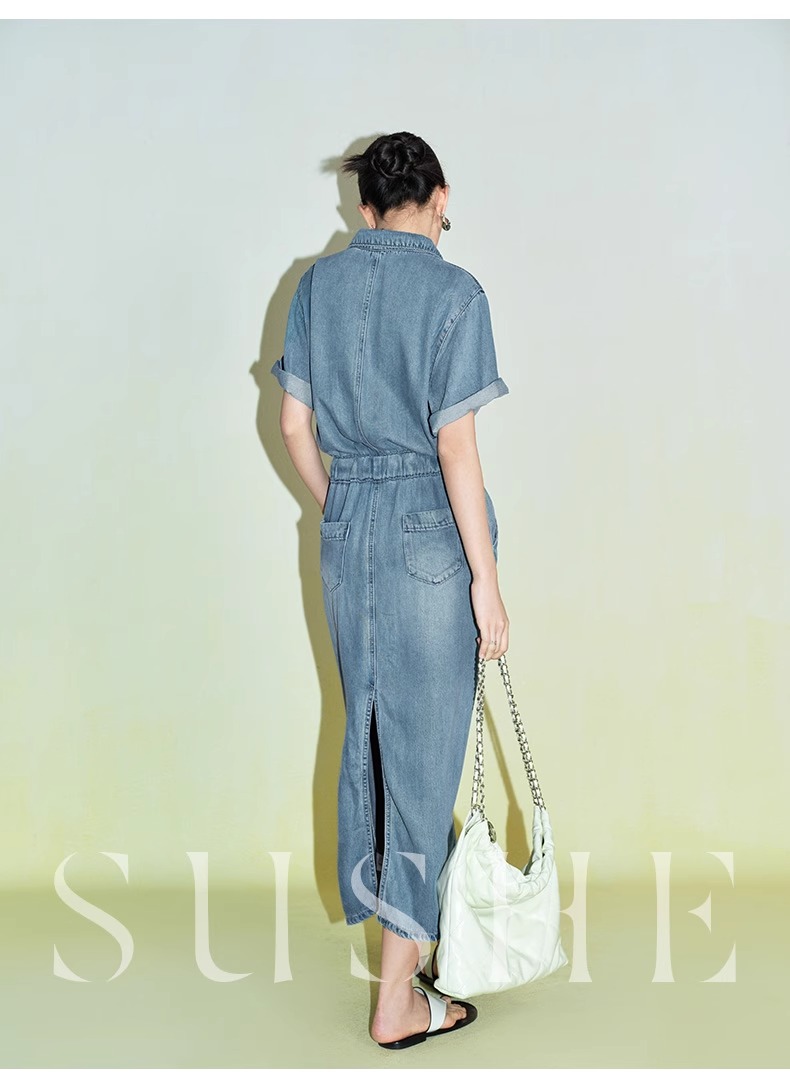
After years of collecting, styling, and occasionally retiring denim dresses, I have developed a framework for identifying the right one that goes beyond “buy what the influencer is wearing.” Start with your lifestyle, not your fantasy self. If you work in an office with a business-casual dress code, look for a dark-wash midi or knee-length shirtdress with a defined waist and minimal distressing — something you can wear with loafers on Tuesday and ankle boots on Friday. If your life is more casual — farmers markets, school pickups, coffee shop work sessions — a lighter-wash A-line or shift dress with a relaxed fit will serve you better than anything too structured. The denim dress should slot into your existing life, not demand that you build a new life around it. For a practical starting point, check out the SUSHE short sleeved straight leg denim dress — a piece that balances structure with ease in a way that works for a remarkable range of body types and style preferences.
Pay attention to the details that mass-market retailers tend to overlook. The buttons should feel substantial in your hand and should be sewn on with reinforced thread — the last thing you want is a button popping off the front placket of your dress in the middle of a meeting. The seams should lie flat against your body without puckering, especially along the shoulder and side seams where tension is highest. The hem should be evenly stitched with no loose threads or uneven folds, and if the dress has a belt, the belt loops should be double-stitched at both ends. These are small things that add up to a garment that lasts versus one that starts falling apart after the third wash. The price difference between a thoughtfully constructed denim dress and a cheaply made one is often less than fifty dollars — a gap that closes almost immediately when you factor in the cost of replacing a poorly made garment after a single season. Buy the better one. Your closet, your wallet, and the planet will all be better off for it.
The denim dress does not ask for permission. It does not apologize for its origins in mines and factories, and it does not pretend to be something it is not. That is precisely why it has outlasted every trend that was supposed to replace it — the jumpsuit, the romper, the co-ord set, the dress-over-pants phase that I hope never returns. Fashion is full of garments that burn bright and fade fast, but denim dresses have the quiet staying power of something that earned its place honestly, one wear at a time, one wash at a time, one decade at a time. Whether your collection starts with a twelve-dollar thrift store find or a designer investment piece you saved for months to afford, what you are really buying is not just a dress — it is entrance into a tradition that stretches back more than a century and shows no sign of stopping.
Sources & References:
• Levi Strauss & Co. Archives — Historical records of denim’s origins as American workwear, San Francisco.
• Statista Global Denim Market Report 2025 — Market valuation, growth projections, and consumer trend data.
• Ellen MacArthur Foundation — Make Fashion Circular 2024 — Garment lifespan and per-wear environmental impact analysis.
• Vogue Business — Celebrity influence on denim dress search trends and retail sales correlation.
• Textile Exchange — 2025 Organic Cotton Market Report — Water usage and emissions data for organic vs. conventional cotton.
• The Business of Fashion — 2025 Materials Report — Denim fabric weight specifications and textile analysis.