

There is a particular kind of garment that flatters almost everyone who tries it and still gets overlooked, and the trumpet skirt is the clearest example I know. I came to mine sideways, after years of believing that a flared hem meant either a stiff formal piece or a girlish summer skirt, and it took one grey October morning to change my mind. I pulled a mid-weight trumpet skirt over thick tights, added a fine knit and a pair of boots, and something clicked: the line fell close through the hip and then opened softly at the knee, so the silhouette looked sculpted rather than fussy, and the horizontal break of the flare made my legs read longer rather than shorter. Within a fortnight it had displaced three other skirts I used to rotate. There is a quiet intelligence to a skirt shaped this way, and once you understand how the flare behaves, you stop thinking of it as a special-occasion piece and start treating it as an everyday one.
What follows is a proper look at the trumpet skirt rather than a passing note of approval. A trumpet skirt is a skirt that fits closely through the waist and hips, stays narrow through the upper leg, and then flares outward from roughly the knee to the hem, so its outline resembles the bell of a trumpet. That single structural decision — hold the line, then release it — is what separates it from an A-line, which flares from the waist, and from a mermaid or fishtail, which flares only in the last few inches near the floor. The trumpet hem is the most wearable of the three because the flare begins early enough to add movement and late enough to keep the shape disciplined. In the sections below I will unpack what the garment actually is, where the silhouette came from, why it suits autumn so well, how it differs from its close cousins, how to get the fit and fabric right, how to wear one in real life, what the consumer data says about flared shapes, and how to choose and care for a trumpet skirt so it lasts for years. If you would rather see the idea in physical form first, there is a considered edit of trumpet skirts already living on the site.
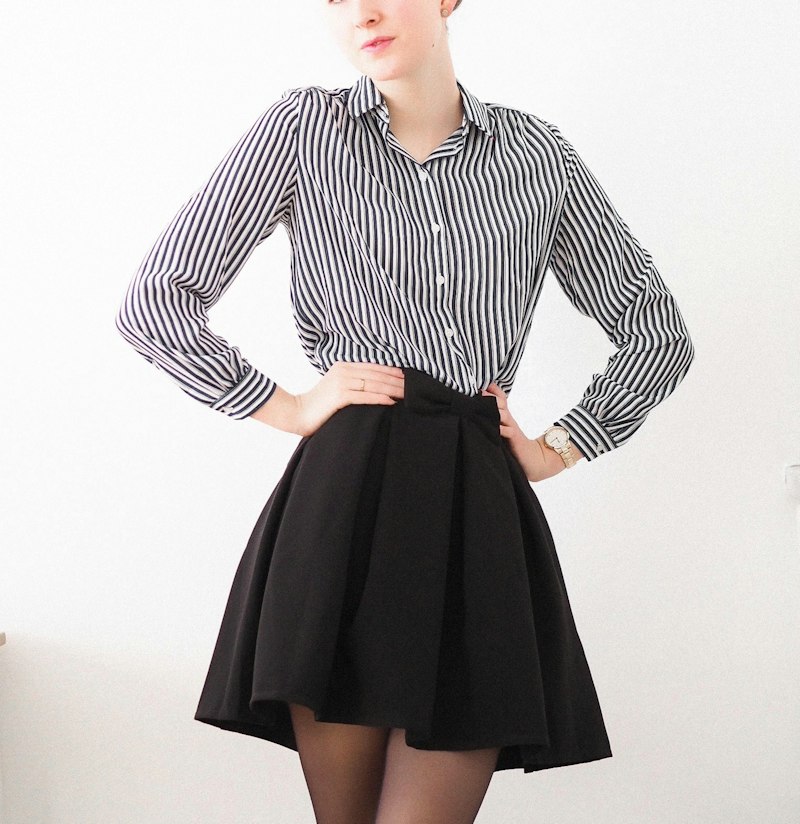
What a Trumpet Skirt Actually Is
Start with the shape, because the shape is the whole idea. A trumpet skirt is built around a controlled flare: it is cut to sit close against the waist and hip, to skim rather than grip through the upper thigh, and then to open outward from around the knee down to the hem. That opening is usually created either by godet inserts — triangular panels set into the seams to add width — or by panels that are cut wider towards the bottom, or simply by a graduated flare worked into the pattern. The result is a hem that is noticeably fuller than the hip while the top half of the garment stays deliberately narrow. The word “trumpet” describes that silhouette precisely: a slender stem that opens into a bell.
That outline is what makes the trumpet skirt feel more considered than a plain flared skirt. Because the flare starts below the widest part of the body rather than above it, the garment does not add visual weight to the hip; instead it creates a soft backward curve that draws the eye down and out in a controlled way. The narrow upper section keeps the waist and hip looking clean and defined, and the movement at the hem gives the skirt life as you walk. In heavier fabrics the effect is architectural and grown-up; in lighter ones it is fluid and romantic. Either way, the same principle is at work — a line that holds, then releases, which is exactly why the trumpet skirt tends to look elegant rather than exaggerated.
It helps to be clear about what a trumpet skirt is not. It is not an A-line, which widens from the waist and therefore creates a continuous triangle rather than a stem-and-bell. It is not a mermaid or fishtail skirt, which stays narrow almost to the ankle and then flares in a sudden, dramatic sweep; those are harder to walk in and far more formal. It is not a pencil skirt, which keeps a straight, close line all the way down. The trumpet skirt sits between them: more forgiving than a pencil, more wearable than a mermaid, and more shapely than an A-line. That middle position is precisely the point, and it is why the shape flatters so many different figures once the flare is placed at the right height.
Where the Trumpet Silhouette Comes From
The idea of a controlled flare is old, and knowing its history explains why it keeps returning. The narrow-waist, spreading-hem silhouette runs through centuries of Western dress, from the structured gowns of the nineteenth century to the bias-cut experiments of the nineteen-thirties, when designers used the fabric’s own weight to create a close fit at the top and a soft sweep at the bottom. What changed in the twentieth century was the willingness to separate the trumpet line from formal evening wear and turn it into something a woman could wear on an ordinary day. The silhouette stopped being a costume and became a cut — a way of shaping fabric that could be applied to wool, cotton or knit as easily as to silk. *As the reference entry on the **skirt** records, the garment has been shaped in countless ways across cultures and centuries, with the flare at the hem one of its most persistent and adaptable forms.*
The mermaid and the trumpet are often confused precisely because they share that ancestry, but they were separated by practicality. Eveningwear used the most dramatic version, flaring only near the floor for maximum red-carpet impact; daywear needed something a person could actually move in, so the flare crept upward, to the knee and sometimes just above it. That shift is what created the modern trumpet skirt and made it useful rather than ceremonial. Once the release point moved to the knee, the hem became loose enough to stride in and the upper section stayed slim enough to flatter, which is the balance that keeps the shape in circulation season after season.
The shape also has a practical history rooted in fabric. A close-cut top and a flared hem is an economical way to make any material behave well: a heavy wool that would cling awkwardly as a straight skirt falls smoothly once it is allowed to open at the bottom, and a lightweight cloth that would look limp as a pencil gains body when it is released into a flare. That is why the trumpet skirt is not the property of any single era or any single budget. It reappears whenever cutters want a garment that reads as sculpted without being difficult to wear, and it disappears only when a mood for shapelessness is briefly more fashionable — before returning, as it always does, because the underlying logic never really goes out of date.
Why the Trumpet Skirt Works So Well for Autumn
Autumn is the season that exposes every weakness in a hemline. Summer forgives thin, flimsy fabric because it is hidden behind warmth and light; winter lets you bury almost anything beneath a coat; but autumn sits in the middle and shows everything — every crease, every cling, every hem that refuses to hold a line. The trumpet skirt is unusually well suited to that in-between stretch. Its narrow upper section keeps a clean shape under a knit, and its flared hem adds movement without adding bulk, so the garment stays elegant while it stays warm. In a heavier fabric it blocks the wind; in a lighter one it works over tights and under a coat. Few single silhouettes carry a whole season as gracefully as this one does.
There is also a mood argument, and it is stronger than it first sounds. As the year turns inward, wardrobes tend to move towards pieces that feel dependable and quietly dressed rather than showy, and style coverage has noted the same drift again and again. *Reporting on how everyday wardrobes have shifted towards practical, lasting pieces, **BBC** fashion writers have observed that shoppers increasingly favour garments bought for warmth, versatility and easy layering over one-season novelty.* A trumpet skirt fits that instinct exactly. It is warm, it is easy to layer, and it looks composed rather than loud — which is precisely what most people want as the light softens and the calendar tightens.
Practicality keeps the shape in rotation once the novelty of a new season fades. A trumpet skirt can be worn on its own in early autumn, pulled over tights and under a wool coat when it turns cold, dressed up with a heel or kept casual with a flat boot. Because the flare sits low, it stays clear of the knee and never fights with the step, so it is comfortable across a long day. Because the upper section is narrow, it tucks cleanly under knitwear and coats without adding bulk at the waist. Those small efficiencies are the real reason the trumpet skirt earns its place in an autumn closet, and they are why one well-chosen version can do the work of several lesser garments across the season.
The Trumpet Skirt Versus the Mermaid and the A-Line
The fastest way to understand the trumpet skirt is to put it beside the two shapes it is most often confused with, because the differences are small on paper and enormous in the mirror. An A-line skirt flares from the waist, so its widest point is at the hem and its lines form a continuous triangle; it is forgiving and easy, but it can read as shapeless if it is not well cut. A mermaid or fishtail skirt stays narrow to the ankle and then releases in a sudden sweep; it is dramatic and formal, but it restricts the step and demands a certain occasion. The trumpet skirt flares from roughly the knee, so it borrows the structure of the first and the drama of the second while avoiding the weaknesses of both.
That difference in the release point changes everything about how the garment reads on the body. Because the trumpet stays close from the waist to the knee, it defines the hip and creates the impression of a longer, leaner leg above the flare; then, because the flare arrives low, it adds grace and movement exactly where an A-line would still be adding width. The result is a shape that flatters through contrast — the eye reads the narrow section as slender and the wider hem as a deliberate, feminine curve. Worn beside a mermaid skirt, the trumpet looks more modern and far more practical; worn beside an A-line, it looks more sculpted and more intentional. It is, in short, the most wearable version of the flared idea.
There is a place for all three, and the choice often comes down to the occasion and the fabric. Choose a mermaid for a formal evening where drama matters and walking is brief. Choose an A-line for everyday ease, for a soft, forgiving line and for casual fabrics. Choose the trumpet skirt when you want definition at the waist, softness at the hem, and a silhouette that looks considered without being fussy — which is to say, for most of the reasons you get dressed in autumn. Understood this way, the three are not rivals but options, and the trumpet is simply the version that works most often without demanding anything in return.
Getting the Fit Right: Length, Fabric and Structure
Because the trumpet skirt depends on proportion, fit matters more here than on almost any other shape, and the first thing to get right is where the flare begins. A well-made trumpet skirt releases at or just below the knee; if the flare starts too high, it turns into an A-line and loses the sculpting effect, and if it starts too low, it becomes a mermaid and restricts the stride. When you try one on, walk a few steps and check that there is enough room at the hem to move comfortably, then look at where the widest point sits in the mirror. On most figures, a flare that opens between the knee and the mid-calf is the sweet spot, because it lengthens the leg above and adds softness below.
Fabric and structure matter just as much. A trumpet skirt in a mid-weight wool or a wool blend will hold its narrow upper section cleanly and flare with a disciplined, architectural line — ideal for dressier daytime wear. A version in a draped jersey or a soft crepe will move more fluidly and read softer and more relaxed. A printed cotton or a crisp taffeta will hold a wider flare and look more playful. What you want to avoid is fabric that is so thin it clings through the hip, because a trumpet skirt needs its upper section to skim, not grip, and a cheap, clingy cloth will expose every line it is meant to hide. Weight and a little structure are your allies here.
Length and hem details finish the job. A trumpet skirt that falls just below the knee is the most formal and the most elegant; one that reaches the mid-calf is the most versatile and the easiest to wear with boots; one that stops at the ankle flirts with being a mermaid and should be reserved for evenings. Look at how the hem is finished, too: a clean, even sweep reads tailored and timeless, while a slit, a panel or an asymmetric cut adds movement and keeps a longer length from feeling heavy. A high waist will draw the eye up and lengthen the leg; a defined waistband will keep the narrow section crisp. Get these three things — release point, fabric weight and hem length — right, and the trumpet skirt will flatter almost any frame.
How to Wear a Trumpet Skirt in Real Life
Start with the everyday autumn version, because it is the one that earns its keep. Choose a mid-weight trumpet skirt in a neutral — charcoal, camel, deep olive or a rich wine — and pair it with a fitted fine-knit jumper tucked at the waist, opaque tights and a pair of leather ankle boots. Keep the palette quiet and let the flare do the talking, adding just one considered accessory: a slim gold necklace, a structured bag, a wool scarf. This is the outfit that carries you through an office day, a long journey or a family lunch without adjustment, and because the skirt holds its line, it still looks composed hours after you put it on.
For a sharper, more polished look, lean into the fabric’s structure rather than softening it. Take a tailored trumpet skirt and add a silk blouse or a light cashmere knit, then finish with a pointed heel or a sleek boot. Keep everything else minimal, because the whole advantage of the shape is its clean narrow top and its soft release, and clutter fights that advantage. A tailored blazer thrown over the shoulders works especially well for an evening, turning the same skirt into something close to occasion wear with almost no effort. Worn this way, a single trumpet skirt covers the ground that people once kept two or three separate outfits to cover.
For the coldest days, treat the skirt as a reliable base and build outward. Pull on thick tights and add knee-high boots, then layer a chunky knit and a long wool coat over the top, and the same skirt that felt light in September carries you deep into November. A knee-length trumpet hem layered under a long coat is an especially effective combination, because the coat handles the weather while the flared hem keeps the silhouette from turning into a shapeless column. If you prefer a lighter feel, a trumpet skirt in a fluid fabric with a tucked turtleneck and flat boots creates a warm, coherent look with almost no effort. Across all three, one well-chosen trumpet skirt can cover most of an autumn week.
What the Data Says About Flattered, Flared Shapes
It would be easy to treat the trumpet skirt as a purely aesthetic choice, but the consumer data tells a consistent story about what people actually wear and rewear. When shoppers are asked why they reach for a garment again and again, comfort, fit and versatility reliably outrank how trend-led a piece happens to be. *According to apparel and consumer research compiled by **Statista**, practical attributes such as comfort, ease of movement and easy styling are among the strongest drivers of repeat wear and repurchase decisions.* That is the exact profile of a trumpet skirt: it is comfortable, it moves easily, and it is simple to style, which is why it tends to survive the trend cycle that first brought it back into view.
Retail and search behaviour points the same way. Style desks that track seasonal buying have repeatedly observed that the modest, wearable, easy-to-layer hemlines sell through across multiple seasons, while the most extreme novelties fade within a year. A purchase grounded in a real need — warmth, movement and polish in a single decision — outlasts one grounded in novelty, and the trumpet skirt answers that need more directly than almost anything else on the rail. That endurance matters to your budget, too, because a piece you still want to wear next autumn is worth far more than one defined by a single season’s headline.
It also pays to think in cost per wear, the only wardrobe arithmetic that genuinely holds up. A well-made trumpet skirt worn three times a week through an autumn costs less each time you put it on than a cheaper skirt and a cheaper pair of trousers bought, worn twice a month, and discarded within the same year. Divide the price by the number of times you realistically reach for something, and the maths is unforgiving: the dependable, versatile garment wins almost every time. The pieces that survive that test are rarely the loudest ones; they are the quiet, well-constructed, quietly confident ones — and a good trumpet skirt sits firmly in that group. Buy one that fits, wear it on repeat, and watch how quickly it pays for itself.
Choosing and Caring for a Trumpet Skirt That Lasts
Almost everyone can wear a trumpet skirt, because the shape is unusually accommodating, but the cut should still respect the figure. If you are petite, choose a hem that stops just below the knee and pair it with a heel or a defined waist, so the flare does not swallow the leg; a lightly flared trumpet in a mid-weight fabric works especially well. If you are tall, you can carry a fuller flare or a slightly longer mid-calf length beautifully. If you are curvy, a high-waisted trumpet that skims the hip and releases at the knee is the most flattering choice, because the narrow top defines the waist while the flare balances the hip. The goal is always the same: keep the release point low, keep the pace clean, and let the contrast do the lengthening.
Care is what keeps a trumpet skirt paying you back season after season, and it starts with reading the label. Wool and wool blends prefer a gentle hand wash or a cool, short cycle and should be dried flat to hold their shape; knits should be folded rather than hung to stop the hem stretching; crisp fabrics like taffeta are best pressed on the reverse with a little steam. Avoid the hottest water and the tumble dryer, which are the fastest way to shrink cotton and deaden the elastane that gives a skirt its comfort. Store the skirt folded or on a sturdy clip hanger so the waistband keeps its shape, and give it a day between wears so the fabric can recover. Treated this way, a good trumpet skirt can look considered for years rather than a single season.
That longevity is really the whole thesis. A trumpet skirt is not the flashiest purchase you will make this autumn, and it is rarely the piece that ends up in the first photograph. It is simply the one you will reach for on the grey mornings, the long days and the evenings when you want to look composed without trying — because it holds the line where the body is narrow and releases it where movement matters most. It replaced, in my own wardrobe, a handful of skirts that never quite did the job between them, and it has done so with a quiet, sculpting elegance that flatters the figure and survives the weather. Choose a flare that begins at the knee, a fabric heavy enough to hold its shape, and a colour you will still love in three months, and the trumpet skirt will quietly become one of the most dependable pieces you own — which, in the end, is the highest compliment a garment can earn.