

A modern cheongsam dress is one of the rare garments that manages to feel both deeply rooted and completely of the moment. I came to it late. A friend wore one to a gallery opening — a deep jujube red, high collared, cut close but never tight — and the room quietly reorganised itself around her. Nobody stared, yet everybody noticed. She looked composed in a way that a strapless gown never quite manages, and I understood, standing there with a glass of wine, that the secret was not decoration but line. That evening sent me looking for one of my own, and the considered edit of women’s dresses on the site is where the search honestly began.
What follows is a proper look at the modern cheongsam dress rather than a passing nod to a trend. I want to explain what the garment actually is now, where its distinctive shape came from, why its silhouette has survived a full century of fashion upheaval, how to wear it without looking like a costume, how to choose a cut that flatters your own frame, and how to look after the delicate silks and embellishments that make the best examples so special. There is a real difference between a museum piece and something you can wear to dinner on a Thursday, and this piece is about the second kind.
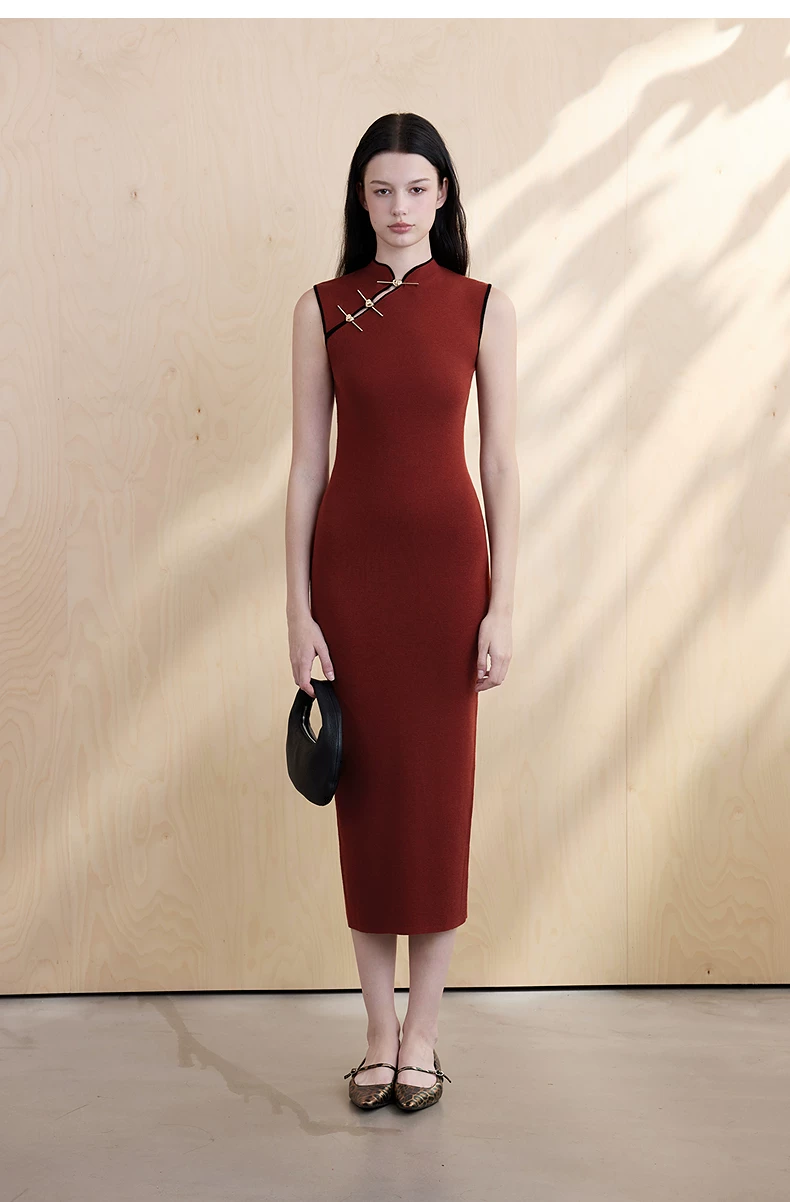
What a Modern Cheongsam Dress Actually Is
At its core, a modern cheongsam dress is a one-piece, body-skimming dress defined by three signature features: a high mandarin collar that stands away from the neck, an asymmetric front opening that closes along a diagonal line rather than down the centre, and side slits that run from the hem upward so the wearer can actually walk. Traditional versions are cut from silk, often brocade or jacquard, and finished with piping that traces every seam. The modern cheongsam dress keeps those three structural ideas and then loosens everything else. The collar may be softer, the slit shorter, the print bolder, the length longer or shorter — but as long as the neck stays framed, the front closes on a diagonal, and the sides open for movement, it still reads unmistakably as a cheongsam rather than a generic fitted dress.
It also helps to be clear about what a modern cheongsam dress is not. It is not a bodycon dress with a Chinese-style print stuck on top; the cut is the point, and a print alone cannot fake it. It is not a costume either, despite what Halloween and period dramas suggest — the version you buy to wear well is a tailored garment, not a theatrical prop. And it is not a rigid vintage reproduction: the best modern versions are engineered for real life, with hidden zips, stretch linings and linings that breathe, so you are not spending the evening holding your breath. Understanding that structure is what separates a cheongsam you wear once from one you reach for all autumn.
From Manchu Robe to Shanghai Silhouette
The lineage matters, because the modern cheongsam dress is a genuine product of cultural exchange rather than a single designer’s idea. Its ancestor is the changpao, the long, loose Manchu robe worn by the ruling class during the Qing dynasty, a garment built for modesty and movement rather than shape. When that influence reached the treaty ports in the early twentieth century, especially Shanghai, dressmakers began to cut it shorter, take it in at the waist and add the slits and collar that we now treat as essential. *The **reference entry on the cheongsam** traces exactly this shift, noting how a loose imperial robe was gradually reshaped into a fitted, modern garment.*
That reshaping happened in a city that was, for a few decades, the most cosmopolitan place in Asia. *As **the history of Shanghai** records, the 1920s and 1930s turned the city into a meeting point of Chinese craft and Western tailoring,* and the cheongsam was the visible result: a dress pressed with a European eye for the waist and a Chinese vocabulary of silk, piping and hand embroidery. By the 1930s the silhouette had lengthened, narrowed and become the emblem of the modern woman. When Chinese communities settled across Southeast Asia and further afield, the dress travelled with them, adapting again in each place. That is why a modern cheongsam dress today can be a floor-length soirée piece in one wardrobe and a printed, everyday shift in another, and both can be correct.
Why the Modern Cheongsam Dress Works in 2026
The reason the modern cheongsam dress keeps returning is structural, not sentimental. Fashion in 2026 has been pulling hard toward quiet, considered dressing — fewer pieces, better cut, less noise — and the cheongsam was built for exactly that brief a century ago. Its power comes from a vertical line: the standing collar lifts the gaze, the diagonal closure draws the eye across the body, and the side slit keeps the whole thing moving instead of gripping. The result is a dress that reads as formal without a gown and as everyday without a T-shirt, which is a genuinely rare position in a wardrobe. It is also remarkably section-agnostic: the same silhouette can carry a wedding, a work dinner, a birthday and a quiet Sunday, provided the fabric and styling shift accordingly.
There is commercial evidence, too, that shoppers are rewarding pieces with this kind of range. *Data compiled by **Statista** on global apparel buying habits has repeatedly shown that versatility and value-per-wear rank among the strongest reasons consumers rewear and repurchase a garment,* which is precisely the promise a well-chosen cheongsam makes. Add the current appetite for artisanal, heritage-rooted craft — the same mood that has lifted brocade, jacquard and hand-worked textiles back into everyday fashion — and the modern cheongsam dress stops looking like a specialist item and starts looking like a smart, grown-up investment. It hoards no space in the wardrobe and asks almost nothing of the wearer beyond a willingness to stand up straight.
How to Wear a Modern Cheongsam Dress Now
The easiest way in is to treat it as the whole outfit and style everything else down. A modern cheongsam dress in deep silk — inky black, jujube red, forest green — needs nothing more than a low, simple shoe, a slim clutch and perhaps a single piece of jewellery, because the piping and collar already do the decorative work. If you want a pair of products to start from, an embroidered silk style like this contrasting slim-fit cheongsam dress shows how much a strong collar and a clean line can carry on their own. Keep the hair simple and the neckline clear; the collar is the frame, and covering it with a heavy scarf defeats the point.
For cooler months, the same dress layers unexpectedly well. Because the slit opens the silhouette, a fine-knit turtleneck worn underneath looks deliberate rather than bulky when the dress is sleeveless, and a cropped jacket or a long wool coat over the top turns the cheongsam into a true autumn piece. Boots soften its formality, while a heeled pump restores it in seconds. For evening, choose the deep satin or brocade version, add a subtle earring and let the fabric do the talking. The rule that holds across all of it is restraint: the cheongsam is a precise garment, and it looks best when everything around it is calm. One strong piece, worn cleanly, will always outclass a busy, over-accessorised look.
Choosing the Right Modern Cheongsam Dress for Your Shape
Because the cut does the work, fit matters more here than in almost any other dress, and the modern cheongsam dress comes in more forgiving variations than most people assume. If you are petite, look for a shorter hemline that finishes at or just above the knee, a slightly lower collar and a slit that stops high enough to keep your stride easy; a printed version with a busy motif will also stop the eye from reading you as short. If you are tall, you can carry a floor-grazing midnight length that only becomes more dramatic the more fabric it uses, and a strong colour or a bold jacquard will read as intentional rather than overwhelming on a long frame.
If you are curvy, the traditional side slits are your friend: they release the hips and thigh while the waist stays defined, so the dress follows your shape without compressing it, and a slightly softer fabric with a hint of stretch will drape rather than pull. If you are straight-figured, look for a style with a belted or seamed waist and a little structure through the bodice, so the dress creates the curve the cut is famous for. Across every shape, three checks matter more than any number on a label: the collar should sit comfortably rather than press on the throat, the waist seam should land on your natural waist rather than a compromise above it, and the slit should let you walk, sit and climb stairs without a second thought. Respecting your own proportions is the whole skill of wearing a cheongsam well.
What Makes a Modern Cheongsam Dress Different From the Original
The clearest way to understand the modern cheongsam dress is to set it beside its ancestor. A traditional qipao assumes a body and then announces it: the fabric is heavy silk, the closure runs the full height of the torso, the collar is stiff, and the slit climbs high enough that the wearer moves in short, careful steps. It is a beautiful garment, and an unforgiving one. The modern cheongsam dress keeps the language — the collar, the diagonal front, the slit — but rewrites the grammar. The lining stretches, the closure is often a discreet hidden zip, the collar is interfaced softly enough to turn your head in, and the slit is measured against a normal stride rather than a photograph. The effect is a dress that still reads as distinctly cheongsam the moment you see it, yet behaves like contemporary clothing when you actually live in it.
The differences show up most in fabric and finishing. Where an heirloom qipao might be built from a single precious brocade, a modern version can be cut in crepe, ponte, tencel or a fluid viscose that drapes and breathes, making it wearable beyond an evening. Where the original favoured dense, all-over embroidery, the modern approach often edits it to a single panel, a contrast-piped collar or a scatter of small motifs, so the craft is present without turning the dress into a display. Pockets are quietly added; linings are labelled; care instructions exist. None of this dilutes the garment — it simply means the modern cheongsam dress carries its heritage lightly, which is exactly why people who would never wear a costume happily wear this one to work, to dinner and to the airport.
Caring for a Modern Cheongsam Dress So It Lasts
Silk, piping and hand embroidery are exactly the details that make a modern cheongsam dress worth owning, and they are also the details that careless cleaning ruins first. Silk loses its lustre when it meets harsh detergent, heat or a tumble dryer, and a printed cheongsam fades long before the fabric itself gives out. Wash sparingly and gently — cool water, a pH-neutral silk detergent, by hand or on the most delicate cycle, turned inside out — and never wring or leave it soaking. If the dress is embroidered, beaded or brocade, do not wash it at all; spot-clean small marks and have it dry-cleaned by someone who understands the fabric. Press on the lowest heat with a cloth between the iron and the silk, and hang the dress on a padded hanger so the shoulders and collar keep their shape.
The final piece of care is storage and rotation. Keep a cheongsam away from direct sun, which strips colour from the silk fastest, and give it room on the rail rather than compressing it against heavier coats that can catch the piping and pull the embroidery. Let it breathe after wearing before it goes back in the wardrobe, and iron or steam the collar first, since that standing line is what the eye notices before anything else. A modern cheongsam dress is one of the few pieces that genuinely improves with good treatment: the silk takes on a deeper sheen, the embroidery settles into its place, and the cut keeps its authority year after year. Bought once and looked after, it becomes the dress you are quietly glad you own — the one you reach for when you want to look like the most composed person in the room.