

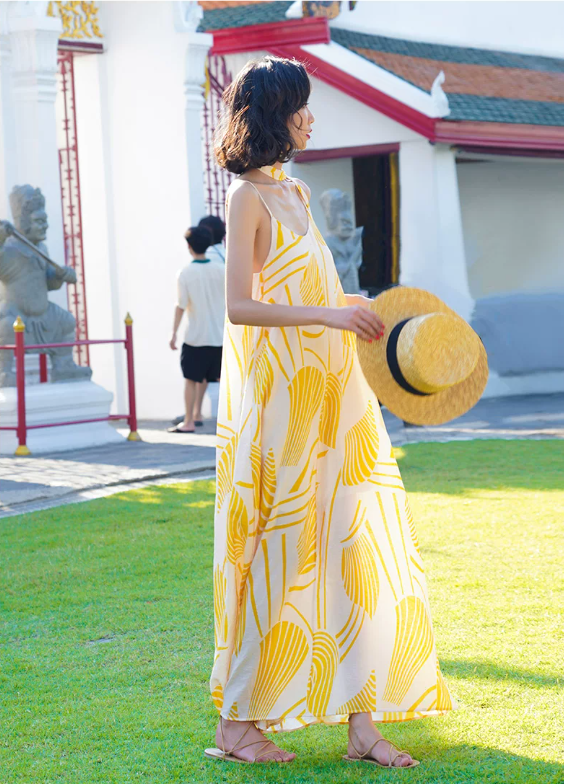
I bought this yellow strap skirt on a Thursday afternoon in July, two weeks before a trip that involved four flights, one wedding-adjacent dinner and a lot of time on a beach that has no shade after eleven in the morning. My plan was simple: one piece that could survive all of it without asking me to think. What arrived was a long bohemian skirt in a shade of yellow somewhere between butter and sunflower, cut on the bias so it moves when you walk, with thin adjustable straps over the shoulders and a matching self-fabric belt that ties at the waist.
I have worn it now for three weeks — twice on sand, once on a plane, once to a dinner where I was underdressed on purpose, and three or four times to the kind of Tuesday that has no occasion at all. That is enough time to stop reviewing it as a photograph and start reviewing it as a garment. So this is not a launch announcement. It is what I noticed, including the parts that annoyed me.
What Actually Happened Between Ordering and Opening the Bag
Ordering was uneventful in the way I want ordering to be. The product page listed the colour as yellow, sizes S through XXL, and a price of $179 against a $199 regular price, which is the sort of discount that tells you nothing except that the brand would like you to buy it now. There was a size note from the model — 165cm, 47kg, wearing an S — and four bullet points about the straps, the belt, the fabric and the lining. What the page did not tell me, and what I had to guess, was the actual length from waist to hem and whether the “silky” fabric meant satin-with-a-sheen or something closer to a summer crepe. Two weeks of wear later, I can answer both, but at checkout I was guessing.
Shipping took five days, which is normal and not worth celebrating, though it did mean the skirt arrived with about a week to spare before I flew. It came folded in a clear plastic sleeve inside a plain mailer, no tissue, no card, no hanger. I mention this not as a complaint — a $179 skirt does not owe me a box — but because it tells you what to expect: the fabric was creased along two hard fold lines when I opened it, and the first thing I did was hang it in the bathroom while I showered to let the steam do some of the work. That helped, but not completely, and I ended up running a low iron over the front panel before I packed it. If you are the kind of person who expects to wear something straight out of the bag, budget twenty minutes.
The one part of the service experience I genuinely appreciated was how the listing handled care. Instead of a vague “hand wash” symbol, the description says cold water, no long soaking, a spoon of salt or white vinegar in the first wash to slow fading, hang to dry, low iron, no dry cleaning. That last instruction is unusual and useful. It also quietly admits something most listings hide: dark and saturated colours bleed. Yellow is not exempt. More on that below, because it is one of the two things I would change.
The Fabric in Hand: Weight, Drape and What It Does at 34 Degrees
The cloth is lighter than I expected and smoother than the word “cotton” would suggest. It reads as a fine synthetic blend with a soft, dry hand — not slippery the way cheap satin is slippery, but with enough surface smoothness that it slides over itself when you move. Held up to a window it is semi-opaque on its own, but the skirt is lined from waist to roughly mid-thigh, and that lining is what makes it wearable in daylight. The lining is the reason I stopped worrying about backlight on a beach at noon, which is a specific and unglamorous kind of relief that no product photo can communicate.
Weight matters more than people admit, and it is the first thing I check on any long bohemian skirt. This is not a heavy one — folded, it fits in the side pocket of a carry-on — but it has enough body that it does not cling to the backs of your legs when the wind drops. Cheap lightweight maxis have a habit of turning into a second skin in humidity; this one hangs. The bias cut does most of that work, and bias cutting is not a marketing word, it is a construction choice with a long history documented in collections like the V&A’s dress archive, where cut-on-the-grain garments from the thirties onward show exactly this behaviour: they stretch, they skim, they recover.
Breathability is decent but not magical. At 34 degrees with high humidity I was comfortable walking, uncomfortable sitting on a plastic chair for an hour, and fine again the moment there was a breeze. That is an honest read for any unlined-at-the-hip summer skirt: the fabric itself moves air, the lining traps a little of it. If you run hot, this is a skirt for evenings and shade, not for a midday hike. If you are normal-to-cool, it will be fine. I also noticed the fabric holds a crease from sitting — a soft diagonal across the lap — which drops out after ten minutes of standing but is visible in photographs taken immediately after you get up.
One quality signal I did not expect: after three weeks and two hand washes there is no pilling at the waistband where the belt rubs, and no pulled threads at the strap anchors, which are the two places this kind of garment usually fails first. The seams inside are finished, not raw, and the hem is a narrow rolled stitch rather than a wide blind hem, which is cheaper to produce but also less likely to sag. As apparel market trackers like Statista’s apparel data keep showing, the mid-price segment is where construction quality varies most; this skirt sits at the good end of that variance.
Fit and Sizing: Notes from Someone Who Is Not 165cm
I am 168cm and usually a size M at the waist and S at the hip, which is the standard problem. I ordered the M and it was the right call, because the belt is doing structural work here: the waist is not fitted, it is gathered, and you set the fit yourself by how tightly you tie. Tied at my natural waist the skirt sat exactly where I wanted it, with the hem grazing the top of my foot in flat sandals. On a 160cm friend who tried it, the same size pooled slightly on the ground, which is fixable with a two-centimetre hem or a higher tie, and worth knowing before you order.
The straps are the part I expected to fight and did not. They adjust through small metal sliders, they are set fairly wide on the shoulder so they do not slip, and the drop from shoulder to the top of the bodice is generous enough that the piece reads as a pinafore rather than a strapless dress with suspenders attached as an afterthought. Because the straps are adjustable, the same garment covered a 165cm frame and a 172cm frame in our group without either of us feeling like we were wearing someone else’s proportions. That is rare in this price band and it is the single best design decision on the piece.
Where it gets less forgiving: the bust. There is no shaping, no dart, no elastic — the top is a straight panel held by the straps, and if you are fuller than a C cup the panel will gap at the side when you lean forward. I am a B and it behaved; a friend who is a D tried it over a bikini top and said she would not wear it without one. The listing’s four bullet points do not mention this, and they should. It is not a flaw exactly, it is a design limit, but it is the kind of limit you want to know about before a holiday rather than after.
Movement is unrestricted, which matters more than any measurement. I climbed into a low beach chair, sat cross-legged on a towel, walked a kilometre on sand and danced badly at a dinner, and at no point did the skirt ride up or require adjusting. The bias cut means the hem swings rather than wraps, so stairs are fine and wind is manageable — though on an exposed beach with a strong crosswind, the lining will show. That is physics, not a defect, but pack a light layer if your beach is windy.
The Belt, the Straps and the Small Decisions That Make or Break It
Design at this price is mostly a series of small decisions, and this skirt makes more of them correctly than I expected. The belt is self-fabric, not elastic and not a contrasting ribbon, which means it disappears into the silhouette instead of announcing itself. It is long enough to tie in a flat knot with tails hanging, or to wrap twice and tuck, and it holds — no slipping after an hour of walking, which is the usual failure of fabric belts on smooth cloth. Because it is the same fabric as the skirt, the tie reads as part of the dress rather than an accessory you forgot to remove.
The straps are thin, adjustable, and anchored with a doubled stitch at the bodice seam. Thin straps on a long skirt is a deliberate proportion choice: the volume goes to the hem and the top stays quiet, which is why the piece photographs as “vacation” rather than “costume”. The trade-off is that thin straps concentrate weight on a narrow band of shoulder. With a skirt this light it is not a problem for a full day; it would become one if the fabric were heavier.
The round neckline sits high enough to wear a normal bra with straps, which sounds trivial until you remember how many summer dresses require an engineering solution underneath. There is no zip, no button, no hook — you step in and tie. That means no hardware to fail and nothing to snag, but it also means no way to fine-tune the top beyond the strap sliders. On a garment with a fitted bodice that would be a problem; on a loose panel it is fine.
The colour deserves its own paragraph. It is a warm mid-yellow, closer to butter than to lemon, and it photographs slightly brighter than it looks indoors. Against tanned skin it reads golden; against very pale skin it can look a little acid in flat fluorescent light. Yellow is also unforgiving about the lining showing through at the pocket area, which it does faintly in strong backlight. None of this is a defect, but if you are choosing between this and the same cut in a deeper colour, know that yellow is the more demanding option.
What $179 Buys, and Whether It Earns Its Place
Let me be concrete, because “good value” is meaningless without numbers. At $179 on sale from $199, this sits in the same bracket as mid-range high-street maxis and well below designer resort wear, which for a lined, bias-cut, adjustable-strap piece with a matching belt is a fair place to be. Lining is the tell. Unlined fast-fashion maxis at $60 to $90 exist, and they look it the moment the sun gets behind them. The lining here is the difference between a skirt you wear to dinner and a skirt you wear over a swimsuit and nothing else.
Cost per wear is the only metric I trust, and it is where a long bohemian skirt either justifies itself or does not. I have worn it seven times in three weeks. At that rate, over a two-summer life — which is a realistic expectation for lightweight summer cloth, not a pessimistic one — the maths lands somewhere near $13 a wear. That is cheaper than two cocktails and considerably more useful. If you only wear it on one holiday a year, it is an expensive photograph. If you live somewhere warm, or travel four times a summer, it will earn out fast.
Durability so far is encouraging but not proven. Two hand washes, no pilling, no seam stress, no colour transfer onto the white towel I dried it on, which surprised me given the care note about fading. The honest caveat is that lightweight summer fabric has a lifespan measured in seasons, not decades, and the bias cut means the hem will eventually go uneven — that is true of every bias garment ever made, including ones at ten times this price. Expect to re-hem once, maybe twice.
Where it compares unfavourably: the packaging and the lack of any styling note. A $179 piece arriving folded in a plain bag with no card is not a scandal, but it is a missed opportunity, especially for a garment whose whole appeal is a specific mood. Brands that sell mood usually hand you a small piece of it in the box. Here the mood is entirely in the cloth, which, to be fair, is where it should be.
Where I Actually Wore It: Beach, Dinner, Airport, Tuesday
On sand, it did exactly what a beach skirt should: pulled on over a swimsuit in ten seconds, tied once, no adjustment for two hours. The lining meant I could walk from the water to a beach bar without reaching for a cover-up, which cut one item out of my bag. The hem collected a little damp sand, which brushed off once dry — worth knowing that you should let it dry before brushing, or you will grind sand into the weave.
At dinner, I swapped the flat sandals for a low block heel and added a thin gold cuff and a small bag, and the piece read completely differently: less beach, more “European town in August”. The yellow does the work here. Nothing about the cut is formal, but the length and the tie waist carry enough structure that a restaurant with tablecloths will not blink. I would not wear it to anything with a dress code printed on an invitation.
At the airport it was the best thing in my bag. It does not crease badly, it does not set off a metal detector, and it works over a t-shirt if the flight is cold, which is a trick worth stealing: layer a plain white tee under the straps and it becomes a different outfit entirely. On a Tuesday, with flat leather sandals and a canvas tote, it was the easiest thing I own. That versatility is why I keep reaching for it rather than the two other long skirts in the same drawer.
The one occasion it failed: a garden lunch where everyone else was in linens and the wind never stopped. The skirt behaved, but the thin straps plus an open back meant I spent the afternoon aware of the sun on my shoulders. A long bohemian skirt this light is a shade garment, not a sun garment. Wear it in the late afternoon, or bring something with sleeves.
Washing, Ironing and the Two Things I Would Change
Care is where the romance ends. The label instructions are specific and, unusually, honest: cold water, hand wash, no soaking, salt or vinegar in the first wash, hang dry, low iron, no dry cleaning. I followed them. After wash one, the water was faintly yellow, which is normal for a saturated dye and exactly what the care note warned about — so wash it alone the first two times, and do not leave it sitting wet in a basin. After wash two, the water ran clear.
Drying takes longer than you think. Hung in shade with a breeze it was dry in about four hours; hung indoors overnight it was still faintly damp at the waistband where the fabric doubles. The skirt needs ironing after every wash — a low iron with a cloth between, moving with the bias rather than against it — and the hem wants a light press or it will hang slightly wavy. This is not a garment you can pull from a suitcase and wear without a glance in a mirror.
So, the two things I would change. First, the colour fastness: it is disclosed, which I respect, but a skirt at this price should not put dye in the basin on wash one, and a pre-washed fabric would solve it. Second, the size information. The listing gives the model’s height and weight and nothing else — no waist-to-hem length, no bust measurement, no note about the strapless-panel limit for larger cup sizes. Two extra lines of measurement would prevent most of the returns this piece will generate, and it would take someone ten minutes to add.
Neither of those is a reason to skip it. They are the difference between a good purchase and a frictionless one, and I would rather write them down than pretend a $179 skirt is flawless.
Who This Skirt Suits, and Who Should Skip It
It suits anyone who wants one long bohemian skirt that works over a swimsuit, under a t-shirt, and at a dinner where nobody is checking. It suits tall-ish frames best because the length is generous, and it suits A-to-C cups because the bodice is a flat panel rather than a shaped one. It suits people who do not mind ironing, or who are willing to hang it in a steamy bathroom and call that good enough.
Skip it if you are under about 158cm and do not want to pay a tailor for a hem, if you are fuller than a C cup and want to wear it without a layer underneath, or if you want a skirt you can machine wash and tumble dry without thinking about it. Skip it as well if you are looking for something structured enough to pass a formal dress code, because the loose panel and tie waist are deliberately casual and no amount of styling will turn them into tailoring. Skip it, too, if you are buying for one photograph — the piece is at its best when it is the third or fourth time you have worn it and stopped noticing it.
What I keep coming back to is that it does the unglamorous job well. It gets pulled on over a wet swimsuit, tied once, and behaves for six hours in heat. The straps adjust, the lining holds, the belt stays tied, the colour is the kind that makes a tan look deliberate. The fabric will not last a decade and the first wash will frighten you slightly, and neither of those facts changes the arithmetic: seven wears in three weeks, more planned, and a skirt that has quietly become the thing I reach for when I cannot be bothered to decide. If that is the job you need done, this one does it — you can see the full details and the size range on the product page here.