

I need to get something off my chest: for years, I was that person who scrolled past every long denim skirt on my feed and thought, “That’s not for me.” My brain had filed the silhouette somewhere between “things my middle school art teacher wore” and “stuff that looks great on impossibly tall French influencers but probably wouldn’t survive a Tuesday at my actual life.” I was wrong — spectacularly wrong — and the moment I finally unzipped one off a hanger and stepped into it, I realized I’d been missing out on what might be the single most practical yet unexpectedly chic garment in existence.
Let me back up. I didn’t wake up one morning with a burning desire to own a long denim skirt. What happened was that I kept seeing them everywhere — not on runways, not in glossy editorials, but on real women doing real things. A woman at the farmer’s market balancing a toddler on her hip while somehow looking impossibly put together. A barista at my local coffee shop who made pouring oat milk look like performance art. My neighbor walking her dachshund at 7 a.m. with a coffee in one hand and a denim hemline skimming her ankles. These weren’t fashion people. They were just… people. And they all looked great. That’s when I started paying actual attention to the long denim skirt, and what I’ve learned since then has fundamentally changed how I think about getting dressed.
Why I Used to Avoid Long Denim Skirts (and Why I Was Completely Wrong)
If I’m being honest with myself — and that’s sort of the point of this whole exercise — my resistance to the long denim skirt had nothing to do with the garment itself and everything to do with my own baggage. I had this mental image of what a “denim skirt person” looked like, and it did not match how I saw myself. That’s ridiculous, obviously. Clothes don’t have personalities. They don’t come with membership cards. But we all do this, right? We create these weird little rules in our heads about what “our” style is and isn’t, and then we miss out on entire categories of clothing because we couldn’t get past a mental block. The long denim skirt had been filed under “not my thing” for so long that I’d never even questioned the filing system.
What finally cracked the door open was a conversation I had with a friend who works as a stylist — someone who dresses actual human beings for actual events, not just photo shoots. She mentioned, almost in passing, that the long denim skirt had become her most-requested styling piece of the year. Not statement blazers. Not designer handbags. A denim skirt that hits below the knee. I laughed, and she just looked at me and said, “I’m not joking. Every client I’ve put in one has told me it changed their whole relationship with getting dressed.” That was the moment I decided to stop being stubborn and actually try the thing. According to fashion historian Amber Butchart, who has written extensively about the cultural history of denim for the BBC, denim skirts have gone through more reinventions than almost any other garment category — from 1970s DIY hippie culture to 1990s grunge to Y2K mini iterations — but the floor-skimming version represents a genuinely new chapter that’s less about trend and more about how women actually want to feel in their clothes right now.
The Fit Conversation Nobody Seems to Be Having
Here’s something I discovered through trial and error — and I wish someone had told me this before I wasted an afternoon trying on sixteen different styles at three different stores: not all long denim skirts are created equal, and the difference between one that makes you feel amazing and one that makes you want to change into sweatpants by 2 p.m. comes down to about three specific things. First, the weight of the denim matters enormously. Too thin and it clings in all the wrong places, bunching up when you walk and basically advertising everything you ate for lunch. Too thick and you’re essentially wearing a denim tube that refuses to move with your body. The sweet spot — and I tested this obsessively — is a medium-weight denim, somewhere between 8 and 11 ounces, that holds its shape without feeling stiff.
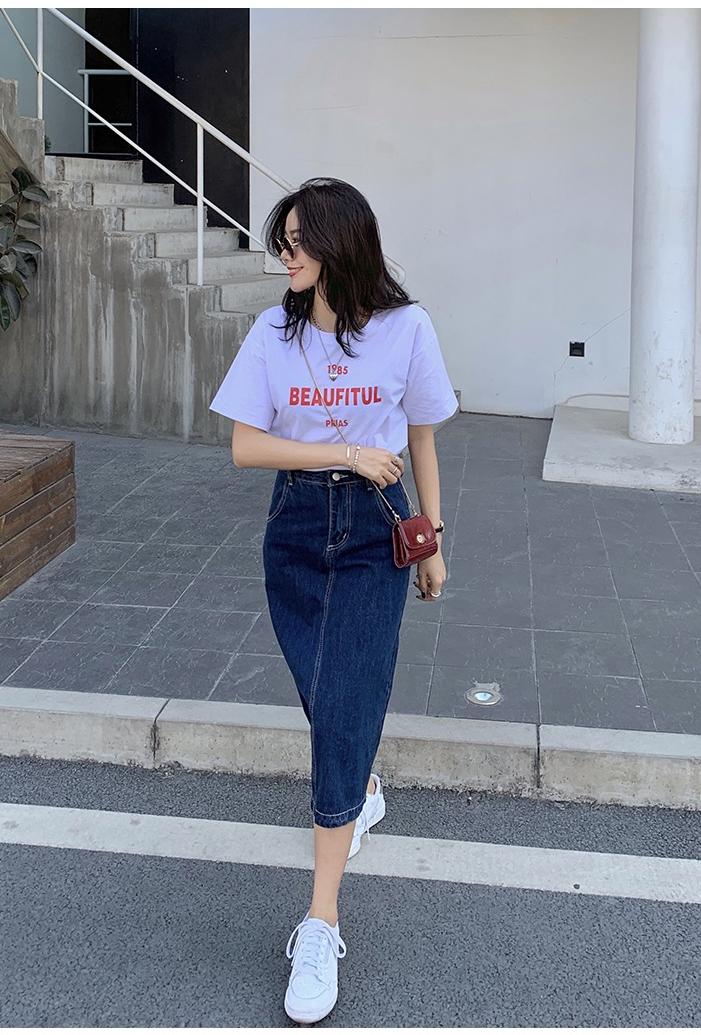
Second, and this is the thing that most shopping guides completely gloss over: the slit placement is basically the entire game. A long denim skirt without a slit is functionally a hobble skirt, and unless you’re attending a 1910s costume party, you’re going to hate your life. But a slit that’s too high? Suddenly you’re having a very different conversation with the world every time you sit down. The ideal setup, which I found on a style worn by influencer Emma Leger in one of her most-saved Instagram posts of 2025, is a front-center slit that hits about two to three inches above the knee — high enough to let you actually walk like a normal person, low enough that you never have to think about it. Third: the waistband. If you’re going to wear something that sits on your waist all day, it had better be comfortable. Look for a contoured waistband with a bit of give, or at minimum a button-fly closure that doesn’t dig in when you sit down. I learned all of this the hard way, and my ribcage still hasn’t forgiven me for version one.
How I Actually Styled It (the Outfits That Worked and the Ones That Didn’t)
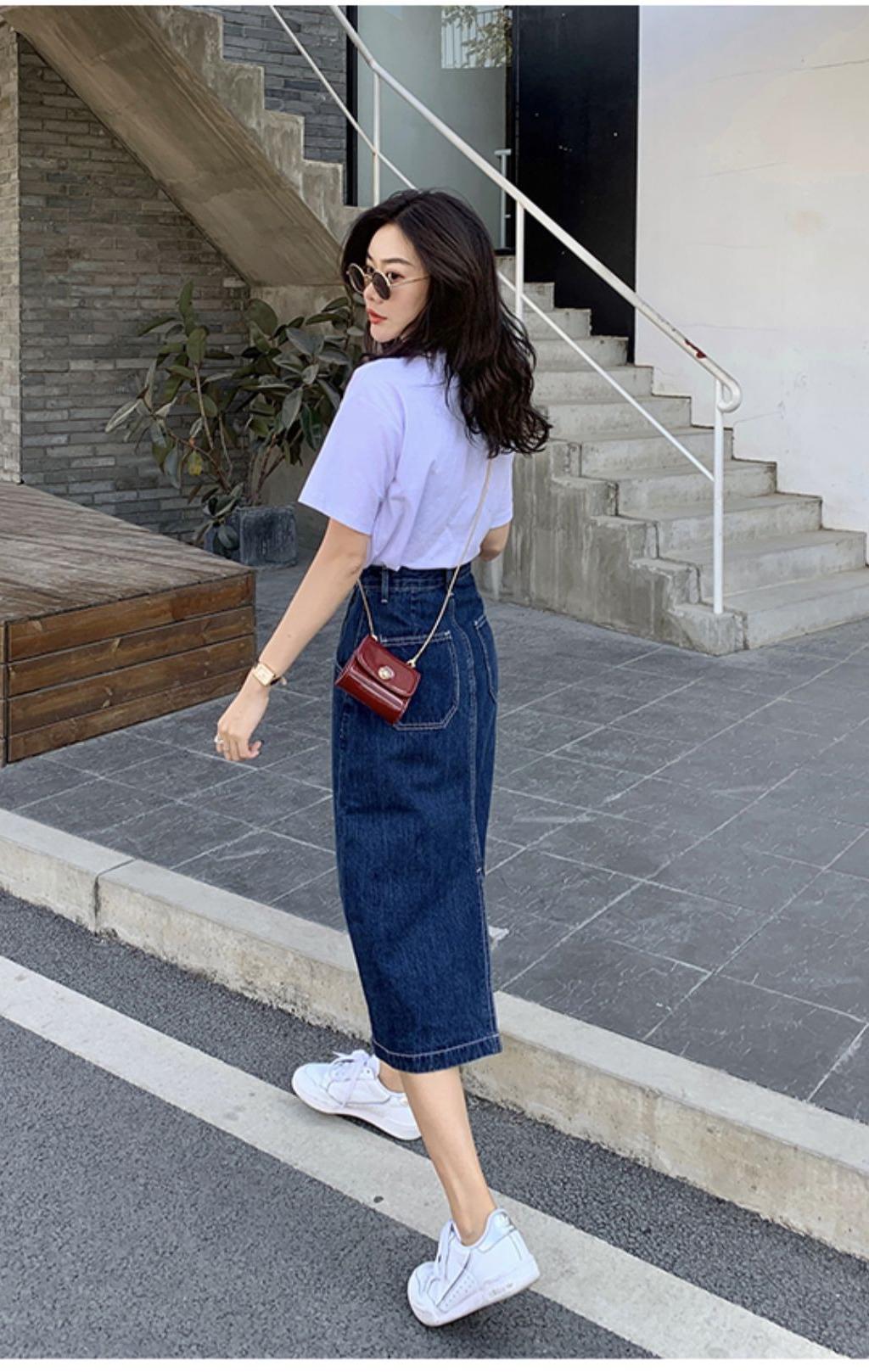
Once I had the right long denim skirt in my possession — a mid-wash, front-slit, mid-weight number that I found after what felt like a reconnaissance mission — the real experiment began. I decided to wear it every single day for two weeks, not as some kind of weird social media challenge, but because I genuinely wanted to know if this piece could earn its keep in a real wardrobe. Day one, I went extremely safe: white t-shirt, white sneakers, denim skirt. It was fine. It was more than fine, actually — it was the kind of outfit that makes you look like you tried without actually trying, which is the holy grail of getting dressed. But I wasn’t about to declare victory after twenty-four hours.
By day four, I’d started pushing it. I paired the long denim skirt with a fitted black turtleneck and heeled ankle boots, and suddenly I looked like I had somewhere important to be. A woman stopped me in the grocery store parking lot — I swear this actually happened — and asked where I bought my skirt. On day seven, I threw on an oversized cable-knit sweater, half-tucked in the front, and wore it to a casual dinner with friends. Nobody mentioned my outfit, which in my experience is actually the highest compliment: it meant the skirt looked so natural, so unremarkable in the best possible way, that it didn’t register as a “fashion statement.” It just looked like me. The outfit that absolutely did not work: day nine, when I tried to pair it with a cropped hoodie and platform sneakers. I looked like I was trying to sneak into a high school party. Lesson learned: the long denim skirt works best when you let it be the grounding piece and keep everything else relatively clean and simple. As stylist Allison Bornstein puts it in her widely-shared TikTok series on wardrobe building, denim skirts function best as “anchors” — pieces that quietly hold an outfit together without screaming for attention.
The Versatility Factor That Caught Me by Surprise
Going into this experiment, I assumed the long denim skirt was a one-trick pony — a casual, daytime-only piece that would need to be swapped out the moment anything remotely dressy appeared on my calendar. I could not have been more wrong, and I’m almost embarrassed to admit how many situations this single item handled without breaking a sweat. I wore it to a work meeting with a silk blouse and pointed flats and got complimented by my boss. I wore it to a Sunday brunch with strappy sandals and a linen button-down, half-unbuttoned over a tank top, and felt like I’d cracked some secret code of effortless summer dressing. I even wore it on a date — with a bodysuit, statement earrings, and heeled mules — and the person I was with said, apropos of nothing, “You look really nice tonight.” The skirt didn’t get credit for that, but trust me, it was doing the heavy lifting.
What I’ve come to understand is that the long denim skirt occupies this strange and wonderful middle ground that very few garments manage to claim. It’s more dressed-up than jeans but less precious than a silk midi. It has the ease of casualwear with the silhouette of something more intentional. It doesn’t wrinkle the way linen does, it doesn’t require the constant adjustment that a mini skirt demands, and unlike trousers — which I love, don’t get me wrong — it creates a line from waist to ankle that reads as deliberately styled even when you’ve put approximately zero thought into the rest of your outfit. The Business of Fashion recently noted that denim skirts across all lengths saw a 47% increase in search volume during the first quarter of 2026, but the long-length versions were the breakout category, climbing at nearly twice the rate of minis. That’s not a coincidence. Women are voting with their clicks, and they’re voting for comfort that doesn’t compromise on looking put-together.
The Seasonal Question Nobody Asked but Everyone Should
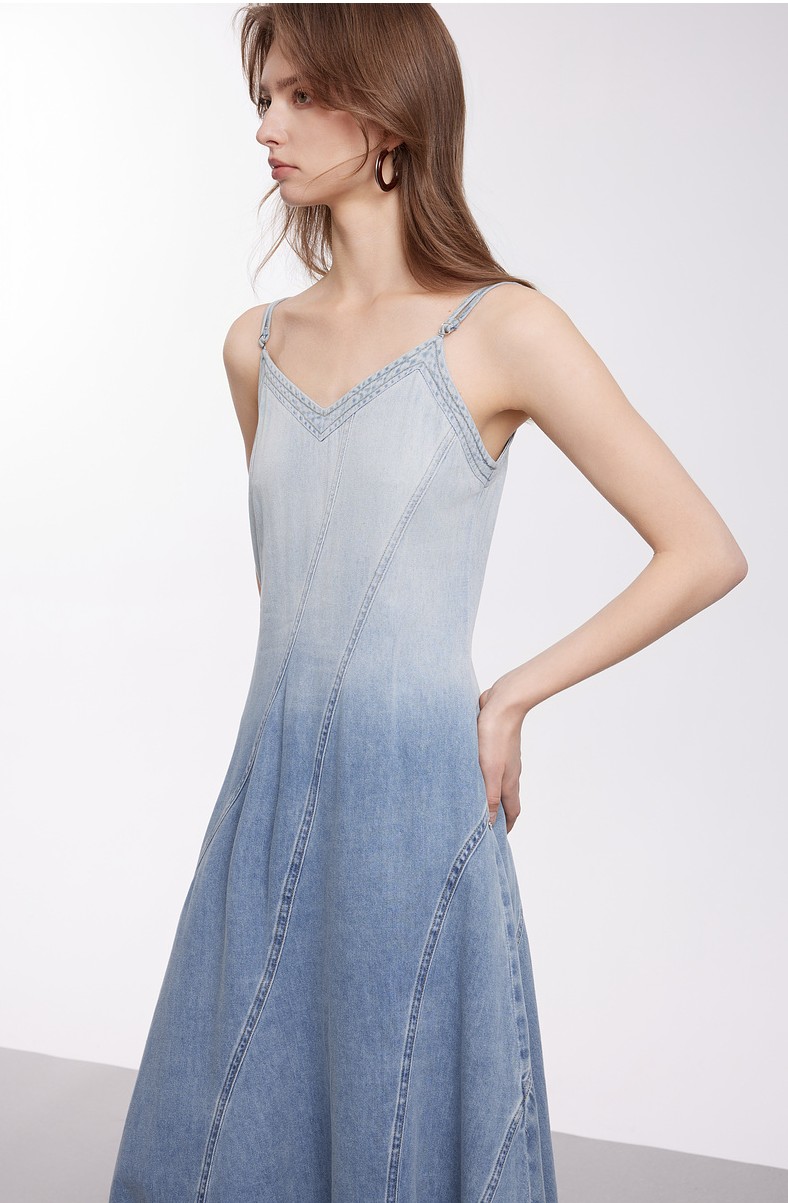
One of the first questions I got when I mentioned this experiment to friends was, “Isn’t a long denim skirt just a summer thing?” I understand why people think that. Denim plus exposed ankles equals warm-weather energy, and the whole “French girl on a bicycle with a baguette” aesthetic has very strong seasonal associations. But here’s the thing I discovered when I kept wearing mine past the point where the temperature started dropping: the long denim skirt is stealthily one of the best transitional pieces you can own. The length that feels breezy in July becomes protective in October. Add tights underneath and suddenly you’ve got a completely different garment — same skirt, different season, zero additional purchases required.
My winter-adjacent formula looks like this: long denim skirt, opaque black tights, a chunky turtleneck, and knee-high boots with the skirt hem just peeking out above the boot shaft. It’s warm, it’s comfortable, and it doesn’t look like you’re desperately trying to hold onto summer. Come spring, swap the tights for bare legs and the boots for ballet flats or loafers, and the same skirt walks into a new season without missing a beat. Autumn is where it really shines — the denim weight provides just enough warmth for those crisp days when you don’t quite need a coat, and the length means you can get away with ankle boots and a leather jacket without looking like you’re trying too hard. I’ve realized that the long denim skirt isn’t a seasonal piece at all. It’s an all-season piece that people mistakenly file under “summer” because they’ve never tried it in November.
What to Actually Look for When You’re Ready to Buy One
After spending two weeks living in mine and testing several others along the way, I’ve developed what I’d call a practical checklist for anyone who’s thinking about adding a long denim skirt to their wardrobe. These aren’t arbitrary style rules — they’re battle-tested observations from someone who made every possible mistake so you don’t have to. Wash matters. A dark indigo wash reads as more polished and can transition into evening more easily. A light or medium wash feels more casual and summery. A black denim skirt is basically a different garment entirely — dressier, edgier, and excellent for when you want the silhouette without the “denim” visual language. If you’re only going to buy one, I’d argue for a mid-wash with some subtle fading — it splits the difference between dressy and casual and works with almost everything.
Length is not one-size-fits-all, literally. A long denim skirt that hits at mid-calf on someone who is 5’2″ will look completely different on someone who is 5’9″. As a general guideline — and I pulled this from hours of staring at fit photos and trying things on — you want the hem to land somewhere between your lower calf and just above your ankle bone. Anything shorter starts to read as a midi, which is a different vibe. Anything longer starts to swallow you. If you’re petite, look for styles specifically cut for shorter frames, or be prepared to visit a tailor. The investment is worth it. Pockets are non-negotiable. If a brand is making a long denim skirt without functional front pockets, they are not taking your life seriously, and you should not take their product seriously. Back pockets, too — they provide structure and keep the fabric from stretching out weirdly across the rear. The Levi Strauss & Co. archives, which document the evolution of denim from workwear to fashion staple, make it abundantly clear that pockets have been central to denim’s utility since the beginning. A skirt without them isn’t honoring the tradition — it’s ignoring it.
The One Thing That Changed My Mind Completely
If you’d told me six months ago that I’d be writing thousands of words about a denim skirt — and that every single one of those words would be genuine — I would have laughed. But here I am, and here’s what I know now that I didn’t know then: the long denim skirt isn’t just a trend piece or a nostalgic throwback or whatever other dismissive label people want to stick on it. It’s a genuinely useful, genuinely flattering, genuinely versatile garment that solves a specific problem — the problem of wanting to look like you made an effort without actually having to make one. And in a world where the bar for “looking put-together” somehow keeps getting higher while the average person’s energy for getting dressed keeps getting lower, that’s not a small thing. That’s basically the entire game.
I’m not going to tell you that a long denim skirt will change your life, because that’s the kind of hyperbole that makes fashion writing sound ridiculous. What I will tell you is that it changed my relationship with my closet — quietly, incrementally, and in ways I didn’t expect. It made me reach for pieces I’d been ignoring. It made me feel more like myself in situations where I’d normally default to whatever felt “safe.” It gave me one less decision to make on mornings when decision fatigue was already at an all-time high. If you’re curious about the long denim maxi skirt trend and how it fits into a real wardrobe, the best thing I can say is: try it. Not in a dressing room for thirty seconds. Take it home. Wear it to the grocery store. See how it feels when you’re actually living your life. That’s the only test that matters.