

The French Style Dress in Wine Red: How Color, Cut, and Cloth Make a Dress That Lights a Room
There is a particular moment, usually in a hallway mirror five minutes before leaving, when a dress stops being an item of clothing and becomes a decision about how the evening will go. You have probably experienced the opposite version of it: a dress that fits, that cost a reasonable amount, that photographs well enough, and yet leaves you adjusting a strap and wondering whether you should change. The difference between those two moments is rarely about price or trend. It is about whether the color, the cut, and the cloth are making the same argument at the same time, and whether the person inside has stopped negotiating with the garment. When those three elements agree, the dress stops being a costume and starts behaving like a tool. A french style dress that gets all three right does something deceptively simple — it removes the need to explain yourself, so you can walk into a room and talk about something more interesting than what you are wearing. A dress that requires maintenance — a strap pulled up, a hem tugged down, a jacket kept on because the back does not sit right — quietly taxes your attention all evening, and other people read that distraction long before they can name it.
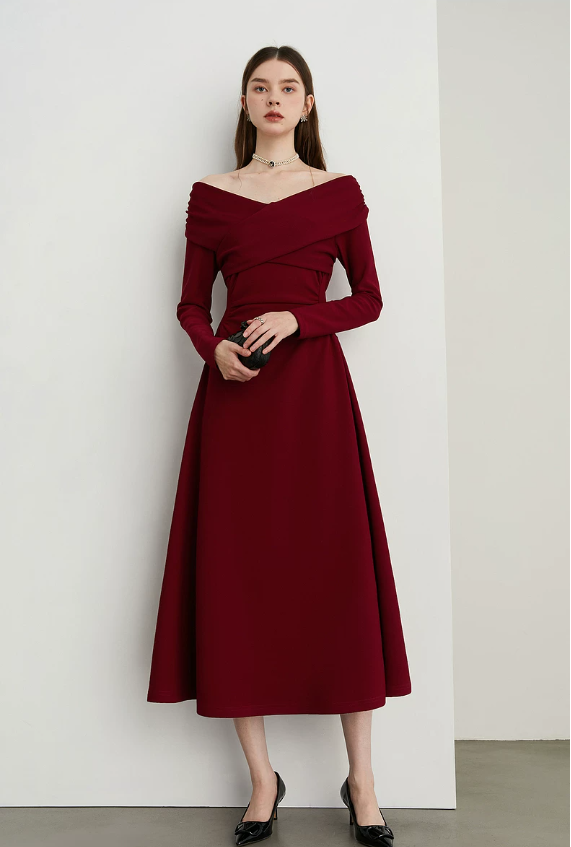
That is the case for the wine-red off-shoulder dress we are looking at here, and it is worth taking apart properly rather than describing it in the usual breathless adjectives. Red is the most physiologically assertive color in the spectrum, and a french style dress cut with restraint is the most reliable way to wear it without shouting. Put those two facts together and you get a garment that behaves well at an engagement party, a formal dinner, and a year-end company banquet — three occasions with completely different social rules and almost no overlap in what they ask of a guest. The thread running through all three is the same: the dress has to hold its line while you forget about it, and that only happens when the dye, the drafting, and the weave were chosen to support each other rather than to hit three separate price points. What follows is a practical breakdown of the color science, the tailoring logic, the fabric behavior, and the styling decisions that decide whether a red dress reads as elegant or as effort. If you want to see the piece itself before reading the reasoning, the wine-red French style dress is the reference point for everything below.
Red Speaks Before You Do, and Hue Decides What It Says
Red occupies the long-wavelength end of the visible spectrum, roughly between 620 and 750 nanometres, which is why the eye registers it faster than any other hue and why it appears to advance toward the viewer rather than sit back on the plane of the fabric. That optical forwardness is the entire reason red is used for warning signs, theatre curtains, and ceremonial dress across an unusual number of cultures. It is also the reason red is unforgiving: a color that announces itself cannot hide a bad seam or a fabric that creases at the hip. The useful part of the physics, though, is that “red” is not one color but a family spanning orange-leaning scarlet, neutral true red, and blue-leaning burgundy. Each sits at a different value and chroma, and those two variables — not the hue name — determine how the dress interacts with a face. Wine red, the shade used here, sits at the blue-leaning end with a relatively deep value and a controlled chroma. When a dress is darker than the skin it covers and cleaner in saturation than the surrounding room, the boundary between face and fabric becomes sharper, and the eye reads the skin as clearer and more even. This is the mechanism behind the familiar claim that a certain red “brightens” the complexion — it is contrast doing the work, not pigment transfer. A bright orange-red at high chroma produces the opposite effect on olive and golden undertones: the fabric competes with the skin, and any redness in the face gets amplified instead of balanced. Deep wine red avoids that failure mode because its blue undertone neutralizes sallowness while its depth keeps the contrast flattering rather than harsh, which is why the same shade works on very fair, medium, and deep complexions without adjustment. According to the reference entry on the color red, the hue has been associated with status and celebration in contexts as far apart as imperial Rome and classical Chinese ceremony — a long record of exactly the social function this dress is being asked to perform.
What the French Style Dress Actually Inherits From Couture
The phrase gets used loosely, so it is worth being precise about what a french style dress borrows from the Parisian tradition and what it does not. It does not mean ruffles, berets, or a particularly narrow silhouette. The couture inheritance that matters is a discipline of line: the neckline, the waist seam, and the hem are designed to agree with each other, and everything that does not serve that agreement is removed. The Metropolitan Museum’s history of haute couture traces the system to Charles Frederick Worth’s Paris atelier in the mid-nineteenth century, and notes that the trade was eventually formalized by French law, with houses required to maintain a Paris workroom and a minimum staff to qualify. What that legal definition protected was not decoration but the practice of fitting a garment to a specific body through multiple toile stages — the reason a well-cut dress feels different from a well-printed one. In a ready-to-wear context, that discipline shows up in three places. First, the waist seam sits at the natural waist rather than drifting upward to create a trendy but short-torso effect, which is what allows the skirt to fall in a clean line from the narrowest part of the body. Second, the off-shoulder edge is drafted as a structural band with an internal grip rather than a stretched elastic, so it stays where it was placed instead of migrating. Third, the closure is hidden in the same tone as the fabric, because a visible zip on a red dress breaks the color field and immediately cheapens the line. None of these details are visible in a photograph, and all of them are visible in a mirror. That is the practical meaning of French restraint: the expense goes into the parts nobody names, which is exactly why the dress can be worn to a formal engagement dinner without needing jewelry to justify it.
Linen Texture With High Elasticity: Structure Without Stiffness
Linen has a reputation problem that is entirely deserved and entirely misunderstood. The fiber is a bast material taken from the flax plant, it is stronger wet than dry, it conducts heat away from the body faster than cotton, and it wrinkles because the fiber has almost no natural elasticity — which is precisely why it looks expensive and precisely why it is difficult to wear in a fitted garment. Pure linen in a bodice will crease across the diaphragm the moment you sit down, and no amount of steaming at the door will save it by the time dessert arrives. The solution the textile industry settled on decades ago is a textured weave with a small elastane content, and the version used in this red French style dress pushes that logic further: a linen-texture surface with high elasticity, so the cloth reads as woven and dry rather than slick, while still recovering its shape after movement. The practical consequences are worth spelling out, because they determine whether the dress survives a real evening. A textured surface scatters light in many directions instead of reflecting it flatly, which visually softens the small pulls and shadows that appear whenever fabric crosses a hip or a ribcage; a smooth satin in the same deep red would show every one of them. High elasticity means the bodice follows the ribcage through sitting, standing, and the particular twisting motion of reaching across a table, then returns to its drafted shape rather than bagging at the waist. It also means the dress can be cut closer to the body without needing a stiff interfacing, so the silhouette stays soft at the edges and firm through the middle — the combination that makes a garment look tailored rather than armored. For anyone who has avoided linen because of the creasing, this is the version that solves the objection without giving up the dry, matte hand that makes deep colors look richer than they do on shiny fabric. The general properties of the fiber are documented in the reference entry on linen, including its low elasticity and its strength when wet, both of which explain why the blend approach exists in the first place.
The Off-Shoulder Line and the Geometry of the Neck and Shoulder
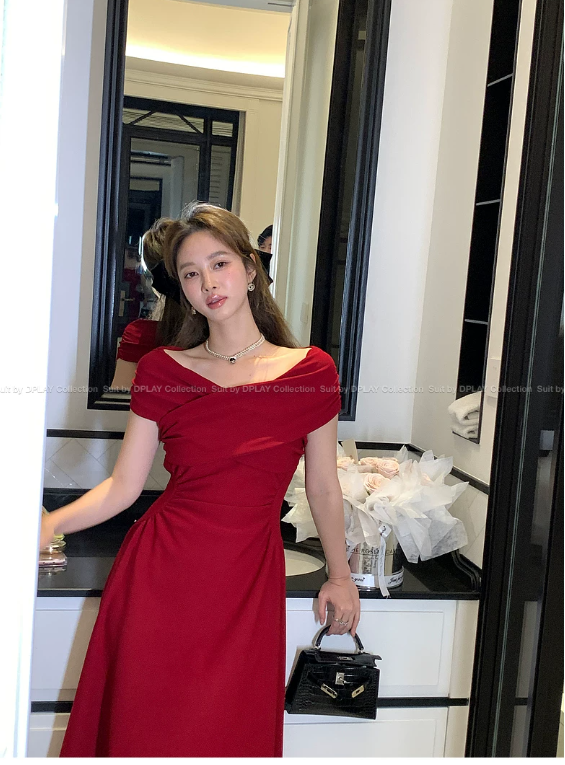
An off-shoulder neckline is a horizontal decision imposed on a vertical garment, and that is why it either works beautifully or fails completely. The band sits below the collarbone, exposing the shoulder line and the base of the neck while covering the upper arm at its widest point. Because the eye completes the horizontal, a well-placed band reads as a clean, squared shoulder even on a body with sloped shoulders — the effect usually described as a defined shoulder line. At the same time, the uninterrupted vertical stretch from the jaw to the collarbone makes the neck look longer, which is why portrait necklines have been used in formal portraiture for centuries and why the same cut appears so often in engagement and evening dressing. The engineering matters more than the aesthetics here. A band that relies on stretched elastic will ride up when you raise your arms and will leave a red mark by the end of the night. The version on this dress is drafted as a structured edge with an internal grip and a hidden same-tone zip at the side, so the neckline stays put through sitting, standing, and the small physical negotiations of a formal dinner. The bodice is then shaped with vertical seams rather than a single horizontal dart, which keeps the front panel smooth and lets the waist be defined without pulling. For readers who worry that off-shoulder means precarious, the test is simple: raise both arms above your head in the fitting room. If the band stays below the collarbone and the waist seam does not lift, the drafting is correct. If either moves, the dress will spend the evening being adjusted, and no amount of styling will fix a structural problem. Worn with the shoulders relaxed rather than held up, the line does what it is supposed to do: it frames the face and leaves the dress to speak in one clean gesture.
Wine Red for Engagements, Banquets, and Year-End Parties
Red is the only color that can be worn to three very different formal occasions without being wrong at any of them, provided the styling shifts. At an engagement celebration, where the couple’s families are meeting and photographs will be taken in every corner of the room, wine red photographs beautifully under mixed indoor light because its blue undertone stays stable while brighter reds shift orange under warm lamps. Keep the accessories minimal and warm — small gold hoops, a thin bracelet, a low-heeled pump in the same tonal family or in a deep neutral. At a formal dinner or banquet, where you are seated for three hours and the room is dim, the same dress benefits from one strong piece of jewelry at the neckline or none at all, since the off-shoulder line already provides the frame. Heels can go higher here, and a small structured bag in black, bronze, or deep green will look deliberate rather than matched. For a year-end company party, the calculation changes again, because the room contains colleagues and the dress code is usually “festive but professional.” This is where the restraint of a french style dress earns its keep: the covered upper arm, the mid-calf or below-knee hem, and the matte textured fabric all read as appropriate, while the color does the celebratory work. Add a tailored coat or a cropped jacket in black, camel, or ivory for the commute, chose a lipstick in the same blue-red family as the dress rather than a warmer orange-red, and let the shoes be the only place you introduce shine. A wine-red off-shoulder dress handled this way moves through all three events without a single change of clothes, which is the actual test of a formal wardrobe piece — not how it looks in one photograph, but how many occasions it survives.
Matching the Neckline and Hem to Your Frame
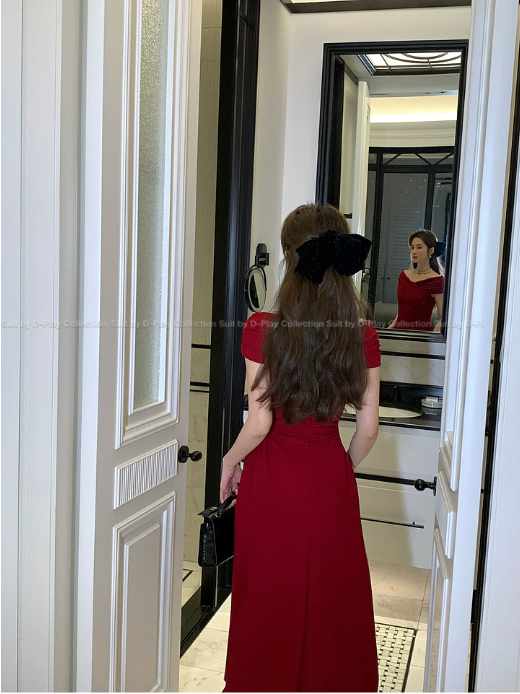
Off-shoulder cuts are usually described as universally flattering, which is generous but not accurate. What is accurate is that the cut can be tuned, and the tuning happens at the hem and at the width of the band. If you are petite, the risk is being swallowed by fabric: keep the hem at or just below the knee, avoid a skirt that flares too far from the body, and make sure the waist seam sits exactly at your natural waist rather than an inch lower, which shortens the leg line. If you are tall, you have the opposite freedom — a mid-calf or ankle-grazing length will balance the horizontal neckline and give the dress the long vertical it was drafted for. If your shoulders are narrow relative to your hips, the off-shoulder band adds visual width exactly where you want it, and an A-line skirt keeps the proportion calm; if your shoulders are broad, choose a band that sits slightly narrower and let the skirt carry more volume so the silhouette stays balanced rather than top-heavy. For a fuller bust, the critical measurement is the vertical depth of the bodice: the band should sit low enough to clear the collarbone but high enough that the front panel does not gape when you lean forward, and the side zip should let you step into the dress rather than pull it over your head. For a straighter figure, the waist seam and the skirt’s drape do the shaping work, and a belt is usually unnecessary — the seam is already saying what a belt would repeat. Two more practical checks belong in every fitting: sit down in the dress and confirm the hem does not ride above mid-thigh, and walk a flight of stairs to make sure the skirt does not require a hand. A french style dress in this cut is designed to be worn with the body moving, not standing still for a photograph, and the fitting should test the former. Get the hem and the band right and the dress will look custom; get them wrong and no accessory will compensate.
Keeping Red Red: Washing, Storing, and Traveling
Deep red is one of the least forgiving colors to maintain, and almost all of the damage happens in the first three washes. The dye load on a saturated wine-red fabric is high, which means the first two or three cold washes will release color into the water no matter what the care label says. Wash the dress alone or with other reds for its first three cycles, use cold water and a detergent formulated for dark colors, turn it inside out, and skip the fabric softener entirely — softeners leave a film that dulls the surface and reduces the matte texture that makes the color look expensive. Never bleach, never use a detergent with optical brighteners, and never leave the dress sitting wet in a machine, because prolonged dampness is what fixes transferred dye into the fibers of whatever else is in the drum. Drying and storage decide whether the color survives the season. Dry the dress flat or on a padded hanger away from direct sun, since ultraviolet light fades red faster than any other hue — this is not folklore but the same photodegradation that turns red signage pink. If you travel, roll rather than fold the skirt to avoid a hard crease line at the hip, and pack the dress inside a cotton bag rather than against a dark leather item, because dye transfer works in both directions and a black bag in a warm car is a reliable way to produce a grey patch. Store it folded with acid-free tissue at the folds, or hanging with the weight distributed across the shoulders rather than the band, and give the dress a day to hang free before wearing it after travel. Handled this way, a well-dyed wine red will hold its depth for years, which is the quiet advantage of buying a color that was never a trend in the first place.
What makes this particular dress worth the maintenance is that it is doing three jobs at once — the color carries the occasion, the cut does the framing, and the fabric keeps the whole thing comfortable through four hours of standing, sitting, and greeting people you have not seen since last year. Most formal dresses manage one of those and negotiate the other two, usually by asking you to keep a jacket on or to change shoes halfway through the evening. If you have been looking for a single piece that covers an engagement, a banquet, and the end-of-year party without turning into three separate purchases, the wine-red French style dress is the one to try on first, and the wider range of occasion dresses is worth a look if you want the same logic in a different color. Try it with the shoes you actually own, in the light you will actually stand in, and give yourself enough time in the fitting room to sit, stand, and walk a few steps before you decide. Then judge the dress on how little you have to think about it once it is on — that is the only measure of a formal dress that still looks right after the photographs have been filed away and the evening is over.