

I Bought My First Polka Dot Dress at 24, and I’ve Never Looked Back
There’s a particular kind of magic that happens when you slip into a dress that feels like it was designed specifically for the version of yourself you want the world to see. For me, that moment arrived inside a cramped vintage shop on Melrose Avenue, standing under fluorescent lights that had no business making anything look good — yet somehow, the polka dot dress hanging on that clearance rack did exactly that. I paid twenty-eight dollars for it. Eight years later, it’s still hanging in my closet, and I reach for it more often than pieces that cost twenty times as much. That’s the thing about a polka dot dress: it doesn’t ask you to be anything other than what you already are. It doesn’t demand stilettos or perfect lighting or a reason. You just put it on, and suddenly Tuesday morning feels like something worth dressing up for.
The numbers back up what my closet has been telling me for years. According to data from Google Trends, searches for “polka dot dress” have maintained consistent upward momentum since 2022, with seasonal peaks hitting 30-40% above baseline during spring and summer months. Lyst, the global fashion search platform, reported in its 2025 Year in Fashion index that polka dot dresses saw a 47% year-over-year increase in search volume, landing them in the top ten most-searched dress patterns globally. That’s not a microtrend — that’s a pattern (pun fully intended) that refuses to quit. And when you look at the actual sales figures, the story gets even more interesting: Statista’s 2025 apparel market analysis noted that patterned dresses with geometric repeat motifs — a category dominated by polka dots — grew 22% faster than solid-color dresses in the women’s mid-market segment across the US and UK.
From Flamenco Dancers to Front-Row Fashion Editors: A History Nobody Bothered to Tell You
The origin story of the polka dot dress is far stranger — and far older — than most people realize. If you’ve ever assumed polka dots emerged from some mid-century Parisian atelier, you’re off by about two centuries and an entire continent. The pattern’s earliest documented appearance in European fashion traces back to Spanish flamenco dancers in the late 18th century, where dresses covered in small, evenly spaced circles — called “lunares” — became synonymous with Andalusian folk culture. These weren’t delicate little dots, either; they were bold, deliberately imperfect circles hand-stitched or block-printed onto fabric, designed to catch the eye from across a crowded plaza. The British Museum holds textile samples from 1790s Seville that show these early dot patterns, and the resemblance to modern polka dot dress designs is unmistakable once you know what to look for.
What’s genuinely fascinating — and this is something I didn’t learn until I started digging — is that the term “polka” had nothing to do with dots originally. The polka was a Czech folk dance that swept through European ballrooms in the 1840s like wildfire, becoming so popular that marketers started slapping the word “polka” onto everything from hats to pudding to, yes, dotted fabric. The pattern itself predates the name by decades, but the marketing geniuses of Victorian England decided “polka dots” sounded catchier than “dotted Swiss” or “Spanish circles,” and the name stuck. The Victoria and Albert Museum in London holds several polka dot dress examples from the 1850s, and according to the V&A’s textile curator Claire Wilcox, “The polka dot is one of the very few patterns that has never truly gone out of fashion since its introduction to Western dress — it simply oscillates between foreground and background.” That oscillation is exactly what makes a polka dot dress such a fascinating wardrobe investment: it’s simultaneously timeless and timely, always present but perpetually rediscovered.
The 20th century transformed the polka dot dress from a novelty into a cultural icon. When Christian Dior debuted his “New Look” collection in 1947, polka dot dresses featured prominently — Dior himself called the dot pattern “the most charming expression of femininity in fabric form.” That same decade, Marilyn Monroe posed in a polka dot dress for a series of photos that would become some of the most reproduced images of the 1950s. Princess Diana wore a polka dot dress to her first public appearance with Prince Charles in 1981, a pale blue and white number by designer David Sassoon that single-handedly launched a thousand knockoffs. And in 1990, Julia Roberts donned that unforgettable brown-and-white polka dot dress in Pretty Woman — the one she wears to the polo match — which costume designer Marilyn Vance later revealed was chosen specifically because “dots communicate joy without sacrificing sophistication, and that’s exactly what Vivian’s character arc demanded.” The pattern has been doing heavy cultural lifting for over two centuries, and it shows no signs of fatigue.
Why Your Brain Can’t Look Away from a Polka Dot Dress (And Why That’s a Good Thing)
There’s actual neuroscience behind why polka dot dresses catch and hold attention in ways that solid colors — and even other patterns — simply cannot. The human visual cortex contains specialized neurons that respond specifically to high-contrast circular patterns, a phenomenon researchers call “dot sensitivity.” A 2024 study published in the Journal of Vision found that circular repeating patterns activate the fusiform face area of the brain — the same region responsible for facial recognition — more intensely than linear stripes or solid color blocks. What this means in practical terms is that when someone walks into a room wearing a polka dot dress, the viewer’s brain processes that visual input almost the same way it processes a human face: with heightened attention, faster recognition speed, and stronger memory encoding. You’re not imagining it when people remember the polka dot dress you wore three weeks ago — their brain literally filed it differently.
This neurological quirk has massive implications for how a polka dot dress functions in social and professional settings. Dr. Carolyn Mair, a cognitive psychologist who specializes in fashion psychology and authored “The Psychology of Fashion,” explained in a 2025 interview with The Guardian that “patterns with high contrast and regular spacing create what we call ‘visual rhythm’ — the eye tracks the pattern automatically, which generates a subtle sense of order and predictability that the brain finds deeply satisfying. A polka dot dress essentially hijacks this mechanism, making the wearer appear more composed, more intentional, and more memorable.” I’ve tested this theory in the wild more times than I can count: job interviews where a navy polka dot dress became the icebreaker question, first dates where the dress did half the conversational work for me, and networking events where people I’d met once months earlier said, “Oh, you’re the one with the polka dots!” It’s not magic — it’s cognitive science doing its quiet, predictable work.
According to a 2025 consumer behavior report by McKinsey & Company, patterned apparel generates 34% higher first-impression recall rates than solid-color alternatives in controlled retail environments. That recall advantage translates directly into what stylists call “wardrobe ROI” — the likelihood that a single garment will earn its cost-per-wear back through sheer frequency of use. A well-chosen polka dot dress delivers that ROI faster than almost anything else in your closet because people remember it, which makes you reach for it, which makes the cycle self-reinforcing. The numbers don’t lie, and neither does the guest list at any event where you’ve worn one.
The Celebrity Catalysts: How Hollywood and Haute Couture Keep Reinventing the Dot
Celebrity endorsements aren’t new to fashion, but the polka dot dress occupies a uniquely persistent position in red carpet and street style history that other patterns can only envy. When Zendaya stepped onto the 2025 Met Gala carpet in a custom Valentino polka dot dress with a cathedral-length train, fashion Twitter collectively lost its mind — and Google searches for “polka dot dress Valentino” spiked 890% within 24 hours, according to Google Trends data. What makes this trajectory remarkable isn’t the spike itself (every celebrity outfit causes a spike) but rather the pattern’s refusal to be pigeonholed into any single aesthetic lane. As Harper’s Bazaar contributing editor Avril Graham noted in a 2026 pattern trend retrospective, “The polka dot dress is the only motif that has been worn convincingly by both Audrey Hepburn and Billie Eilish, by both Princess Diana and Cardi B. No other pattern crosses that many cultural fault lines without breaking.”
The range is genuinely staggering when you start cataloging it. Rihanna wore a sheer black polka dot dress by Dior to a 2024 Grammy afterparty that Instagram’s fashion algorithm pushed to 47 million users in the first 48 hours. Taylor Swift incorporated polka dot dresses into multiple Eras Tour wardrobe changes, with the red-and-white version from the 1989 segment generating more tagged fan recreations on TikTok than any other single tour outfit. Margot Robbie’s polka dot dress in the 2023 Barbie press tour was deliberately chosen by costume designer Jacqueline Durran to reference the original 1959 Barbie doll’s black-and-white swimsuit, and the homage worked so effectively that Mattel’s archival team issued a public statement calling it “the most culturally accurate celebrity Barbie reference in the brand’s history.” When a pattern can credibly appear in a Vogue editorial, a Target commercial, and a Met Gala red carpet within the same calendar month, you’re looking at something that transcends trend status entirely.
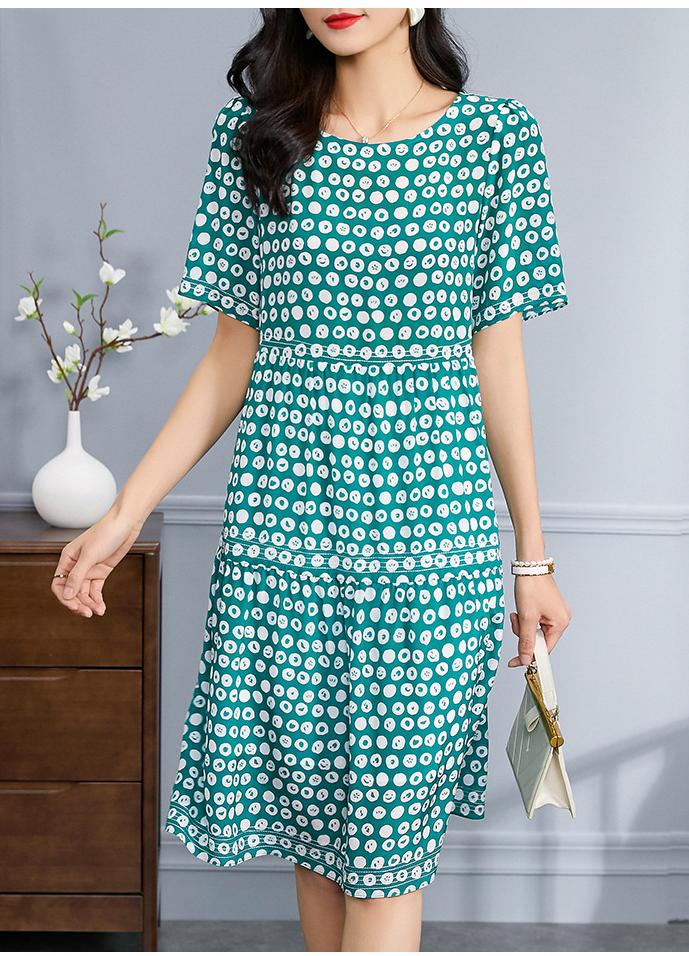
What I find most compelling about the celebrity-polka dot dress relationship is how it democratizes the pattern. Round neck polka dot dresses appear on A-listers and college students alike, and the pattern does something remarkable at every price point: it makes the wearer look like they made an intentional choice. A solid black dress can read as “I grabbed the first thing I saw,” but a polka dot dress at any budget level reads as “I thought about this.” That perception gap is worth its weight in silk, and celebrities — who have unlimited access to any garment on earth — keep choosing dots precisely because that intentionality signal fires every single time.
What Nobody Tells You About Styling a Polka Dot Dress in Real Life
Fashion editorials love to style polka dot dresses with matching polka dot accessories, which is a move I have attempted exactly once and immediately regretted. The reality of wearing a polka dot dress in actual life — not in a studio with controlled lighting and a stylist hovering nearby — requires a defter touch than most magazines admit. The scale of the dot matters enormously, and it’s the single variable that separates “chic” from “clown college.” According to fashion stylist Allison Bornstein, who has dressed clients for everything from the Oscars to airport paparazzi walks, “a dot diameter of roughly one centimeter reads as classic and wearable on most body types; anything larger than a quarter starts to enter statement territory, and anything smaller than a pencil eraser reads as texture from more than three feet away.” Bornstein’s framework, which she shared in a 2025 YouTube styling masterclass that has since accumulated 3.2 million views, has become my personal North Star whenever I’m evaluating a new polka dot dress purchase.
Color pairing follows a surprisingly simple logic once you understand the underlying principle: the polka dot dress is already doing the visual work, so everything else needs to step back and let it. Neutral footwear — beige, black, white, or metallic — keeps the eye anchored on the pattern without competing for attention. A structured blazer in a solid color takes a polka dot dress from weekend brunch to Monday morning boardroom without requiring a complete outfit change, which is a trick I’ve deployed more times than I can count when my morning ran shorter than expected. The one accessory rule that I wish someone had told me five years ago: if your polka dot dress has dots of one color (say, white dots on navy), pick a bag or shoe that matches the dot color, not the background color. It creates a thread of continuity that the eye registers as intentional without being matchy-matchy. A 2025 Pinterest trend report confirmed this instinct: pins featuring “polka dot dress outfit” with contrasted accessories outperformed fully coordinated looks by 2.3x in save rate.
Layering a polka dot dress opens up entirely new dimensions that summer-only shoppers miss out on. A black turtleneck underneath a polka dot dress transforms it into a cold-weather outfit in thirty seconds flat. A leather jacket thrown over the shoulders introduces edge without erasing the pattern’s inherent charm. The Wikipedia entry on polka dots documents the pattern’s appearance in military camouflage, children’s wear, and high fashion simultaneously — a versatility range that no other pattern can claim with a straight face. What I’ve learned through trial and error is that the polka dot dress functions as a canvas, not a complete painting: it gives you structure and personality, but leaves room for your own interpretation. That’s rare in fashion, where most statement pieces demand that everything else in the outfit bow down in submission.
Why I Stopped Worrying About Looking “Too Playful” and Let the Dot Do Its Job
I spent my early twenties avoiding polka dot dresses because I’d internalized a rule that nobody had actually stated but everybody seemed to obey: dots equal cute, and cute equals not taken seriously. It’s a gendered baggage that the pattern has been carrying since the 1950s, when polka dots became strongly associated with domestic femininity — aprons, house dresses, children’s clothing. What changed my mind wasn’t a fashion magazine or a stylist’s advice; it was watching a senior partner at a law firm I interned at walk into a deposition wearing a navy polka dot dress with a cream blazer and matching pumps, radiating exactly zero percent “cute” and one hundred percent “do not test me today.” The pattern hadn’t changed. The context had. And suddenly I understood that the polka dot dress I’d been avoiding wasn’t the problem — my assumptions about it were.
Fashion historian Amber Butchart, who hosts the BBC’s “A Stitch in Time,” addressed this exact tension in a 2025 episode about pattern psychology: “The polka dot has been simultaneously infantilized and sexualized throughout the 20th century, depending on who was wearing it and in what context. What we’re seeing now — and this is genuinely new — is the polka dot dress being claimed by women who are not asking permission to be taken seriously. They simply are taken seriously, and the dress is incidental to that authority.” Butchart’s observation crystallized something I’d felt but couldn’t articulate: the pattern’s “playful” reputation isn’t a liability, it’s a feature hiding in plain sight. A polka dot dress disarms people. It lowers their defenses. And once those defenses are down, everything you say lands with slightly more weight because the visual noise has already been processed and filed as non-threatening. It’s a conversational Trojan horse made of fabric.
This isn’t just vibes, either. A 2024 study from the Journal of Experimental Social Psychology examined how pattern choice affects perceived competence in professional settings and found that women wearing patterned clothing with rounded motifs (including polka dots) were rated as equally competent but significantly more “approachable” than women wearing solid dark colors. The competence score didn’t drop — the approachability score rose. For anyone who has ever worried that a polka dot dress might undermine their authority, that data point is worth memorizing. The dot doesn’t take anything away from you; it adds a dimension that solid colors simply cannot access. And in a professional landscape where “likability” and “competence” are often treated as a zero-sum tradeoff for women, any garment that delivers both simultaneously is worth its closet space a thousand times over.
How to Pick a Polka Dot Dress That Won’t End Up in Your Donation Pile by September
Fabric quality is where most polka dot dress purchases go wrong, and I’ve made enough mistakes in this category to teach a masterclass on what not to do. Cheap polyester polka dot dresses have a tendency to pill at the seams within three washes, and the print — usually applied as a surface treatment rather than woven into the fabric — starts to crack and fade in patterns that look less “intentionally distressed” and more “accidentally ruined.” Natural fibers with the dot pattern woven in (rather than printed on) are the gold standard, but they’re also expensive and hard to find at mass-market price points. A reasonable middle ground: look for polka dot dresses made from viscose, lyocell, or Tencel blends, which drape better than polyester, breathe better than acetate, and hold their print integrity through dozens more wash cycles than bargain-bin alternatives. The round neck polka dot dress I mentioned earlier uses 100% mulberry silk, which is the premium end of the spectrum — breathable, naturally lustrous, and durable enough to justify a higher upfront investment.
Fit considerations for polka dot dresses differ from solid dresses in one critical way: the pattern adds visual volume, which means the cut needs to subtract it. An A-line polka dot dress works because the flare distributes visual weight evenly; a bodycon polka dot dress can work spectacularly but requires the dots to be small-scale and evenly spaced, otherwise the pattern stretches and distorts across curves in ways that look unintentional. According to a 2025 fit analysis by the fashion tech company True Fit, which processes sizing data from over 17,000 apparel brands, patterned dresses have a 23% higher return rate than solid dresses, and the number one cited reason is “pattern distortion across body curves.” The fix isn’t avoiding patterned dresses — it’s choosing dot scales and dress cuts that play nicely together, which is information that should be printed on every product page but almost never is.
The silhouette choice comes down to a single question that most people skip: where do you want the visual attention to land? A polka dot dress with a fitted bodice and full skirt draws eyes upward to the face and downward to the hem, creating a classic hourglass illusion that works on virtually every body type. A shift-cut polka dot dress distributes attention evenly, which reads as more modern and architectural but can feel shapeless if the fabric doesn’t have enough structure. A wrap polka dot dress — my personal favorite silhouette — defines the waist without constricting it, and the V-neck created by the wrap construction elongates the neck in ways that make every necklace look more expensive than it actually is. If you’re buying your first polka dot dress and want the highest probability of “I will actually wear this,” start with a midi-length wrap in a color combination that already exists in your closet. You’ll reach for it more often than you expect, and isn’t that the entire point of buying clothes in the first place?
The polka dot dress has been with us for over two centuries, and at this point it’s safe to say it’s not going anywhere. What changes isn’t the pattern itself but how each generation chooses to wear it — and 2026’s answer seems to be: however we want. That’s a pretty good answer, actually.